

- Home
- Companies
- Opgal Optronic Industries Ltd (OPGAL)
- Articles
- The Autonomous Eye: Architecting the ...
The Autonomous Eye: Architecting the Future of 24/7 Methane Management with AI-Powered Continuous OGI Systems
The energy sector faces escalating regulatory scrutiny and mounting operational complexity. Traditional LDAR relies on labor-intensive, periodic manual monitoring, creating gaps in fugitive methane management. This shift toward fixed Optical Gas Imaging (OGI) technology augmented by Artificial Intelligence (AI) enables autonomous, continuous vigilance, establishing an unblinking safety architecture for real-time detection with reduced false alarms and improved compliance in petrochemical and energy facilities.
Introduction: The Critical Need for Continuous Visibility
The modern petrochemical complex comprises advanced processes and a critical emissions risk. For decades, LDAR operated on campaign-based surveys using handheld OGI or thermal imaging, typically quarterly or annually. This snapshot approach is reactive and increasingly outpaced by regulatory expansion, including EPA OOOOb/c guidelines and Subpart W reporting by 2026. CTOs and Innovation Managers must pursue continuous, uninterrupted visibility, moving from snapshot LDAR to continuous LDAR. This article outlines the architectural shift from a single thermal camera to an integrated autonomous ecosystem powered by OGI and AI.
The Operational Fragility of Snapshot LDAR
Limitations of quarterly surveys affect compliance, profitability, and safety.
The Problem of Intermittent Leaks
Technicians can only survey assets on a scheduled basis. A major leak that begins after a manual survey can bleed product for hours or days before the next check, potentially triggering regulatory events and significant losses. Handheld OGI cannot address events that occur between surveys.
The Efficiency Trap
Manual OGI surveys, while more efficient than legacy sniffers, still require substantial organizational resources. Accessing hard-to-reach connectors often demands permits, scaffolding, or shutdown workflows, slowing inspection velocity and increasing the Man-Hours per Survey (MHPS).
Human Subjectivity
Even highly sensitive OGI devices rely on human interpretation. Fatigue and varying experience levels can introduce inconsistencies in plume detection, creating data gaps in the compliance record.
Transitioning to The Autonomous Eye: Fixed OGI
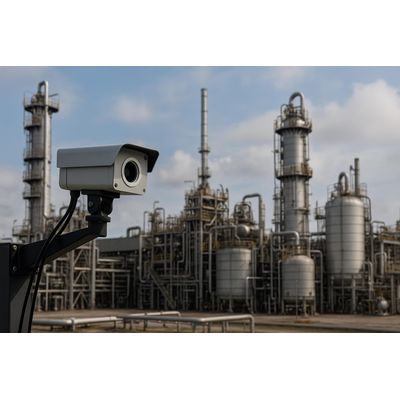
To address intermittency, the architectural shift is to permanently install fixed OGI systems in high-risk zones, delivering continuous data streams from assets such as tank batteries and compressor stations. A fixed infrared OGI sensor provides uninterrupted visibility and forms the foundation for real-time detection. However, fixed installation alone does not equate to autonomy; early deployments produced unmonitored data streams where video was not actively reviewed.
The AI Mandate: Intelligence over Automation
True autonomy requires the integration of advanced hardware with edge computing. Fixed OGI systems must embed AI to avoid false alarms, the Achilles heel of early automated solutions. False alarms arise when non-hazardous events such as steam, fog, dust plumes, birds, or environmental temperature shifts trigger detections. Contextual plume analysis mitigates this risk through:
- Context: distinguishing steam/dust movement from genuine hydrocarbon releases
- Geometry: analyzing plume geometry to locate the leak origin
- Correlation: cross-referencing temperature, gas concentration, and other sensor inputs before triggering an alert
With AI-enhanced analysis, fixed OGI systems move from automation toward autonomy, capable of alerting the control room only upon validated leaks rather than recording data passively.
Sentinuum24: Establishing the Authority of Zero Failure Safety
The Sentinuum24 continuous OGI solution embodies continuous, AI-validated visibility. It provides:
- Zero reaction time: High-definition OGI sensors continuously scan high-risk zones; leaks are identified, AI-validated, and prioritized for the control room within minutes of onset.
- Data-driven compliance: A continuous emissions data stream creates a digital twin of facility emissions, enabling validation of compliance with EPA OOOOb/c and Subpart W standards.
- Data security and scalability: Edge computing enables immediate analytics with minimal bandwidth by uploading only alarm events, aligned with industrial cybersecurity practices.
Operational ROI: The Business Case for Autonomy
Autonomous visibility delivers safety and efficiency benefits. Key economic implications include:
- OPEX reduction: Fixed OGI installations reduce recurring LDAR costs associated with labor, equipment rental, and permits, with substantial reductions in Man-Hours per Survey for monitored zones.
- Asset and environmental protection: Immediate detection prevents minor leaks from escalating, preserving infrastructure and reducing environmental impact, including potential MERP methane waste charges estimated at $1,500 per metric ton by 2026.
- Defense against third-party claims: With satellite monitoring under EPA programs, a fixed, continuous OGI system provides real-time proof of detected leaks and mitigations, countering false satellite claims.
Shaping the Next Decade of Industrial Safety
The shift from periodic, human-centric LDAR to continuous, AI-validated surveillance represents a definitive leap in industrial safety and compliance. Sentinuum24 is positioned as a foundational platform designed for integration with industry CTOs and Innovation Managers to architect autonomous OGI networks for the coming decade, transforming OGI from a diagnostic tool into a tireless sentinel for safety, compliance, and product integrity.
The future of LDAR is unblinking. It is autonomous. And it is already here.
Original: https://www.opgal.com/blog/blog/the-autonomous-eye-architecting-the-future-of-24-7-methane-management-with-ai-powered-continuous-ogi-systems/