
- Home
- Companies
- Opgal Optronic Industries Ltd (OPGAL)
- Articles
- The Comprehensive Guide to Global ...
The Comprehensive Guide to Global Emission Compliance: Navigating EPA OOOOb/c, Subpart W, and the New OGI Standard
The global energy sector is undergoing a regulatory shift that makes high-precision methane quantification mandatory rather than voluntary. With EPA OOOOb and OOOOc finalized and EU methane regulations advancing, operators must rely on Optical Gas Imaging to meet compliance obligations and demonstrate verifiable emissions data.
The Regulatory Shift: From NSPS OOOOa to the OOOOb/c Era
For nearly a decade NSPS OOOOa served as the primary framework for the oil and natural gas industry, but its scope was largely limited to new or modified sources. The introduction of EPA OOOOb for new, modified, and reconstructed sources and OOOOc for existing sources represents a 400% increase in the regulated infrastructure and data collection burden.
The “Super Emitter” Response Program SERP
The EPA has authorized certified third parties to identify large methane releases using satellite data, aerial flyovers, and remote sensing. When a Super Emitter event is reported, operators must investigate and report back within a strict timeframe. This enforcement model requires operators to deploy high-sensitivity methane detection capabilities in near real time to verify or debunk third-party claims.
Appendix K: The Technical Blueprint for OGI Compliance
Appendix K is the definitive technical standard for the LDAR industry, elevating OGI from a best practice to a strictly regulated protocol. Compliance with OOOOb/c is predicated on adhering to Appendix K, which governs all aspects of gas imaging camera use in the field.
Equipment Performance Requirements
- Response Factor: Cameras must prove capability to detect specific gas compounds across varying thermal contrasts.
- Detection Sensitivity: Systems must identify leaks previously undetectable by traditional Method 21 sniffers.
- Documentation: Each survey must be digitally recorded and archived, creating a digital twin of the facility’s compliance history.
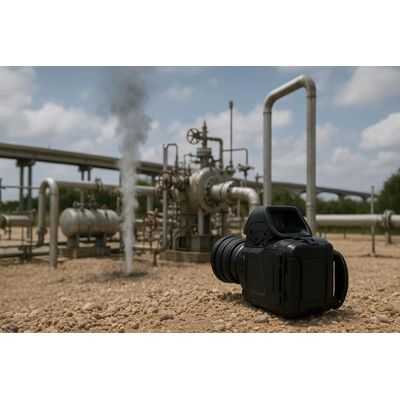
Opgal’s EyeCGas Multi was engineered to exceed these requirements. With a NETD of <10mK, it is among the most sensitive handheld OGI cameras available, ensuring small leaks are captured and documented to support compliance.
Subpart W and the Methane Waste Charge
Subpart W, under the Greenhouse Gas Reporting Program, focuses on quantification rather than detection alone. Recent updates eliminate many generic emission factors used for footprint estimation based on equipment counts.
Under the Inflation Reduction Act IRA, the Methane Emissions Reduction Program MERP introduces a Waste Emissions Charge that begins at $900 per metric ton of methane in 2024 and rises to $1,500 by 2026. Quantifying leaks in real time with OGI enables prioritization of repairs based on actual financial and environmental impact rather than estimates.
Using an OGI system with built-in quantification (QOGI) capabilities, such as those in the Opgal ecosystem, supports moving from population-based estimates to empirical measurement, enabling HSE managers to prioritize remediation with real-time mass-flow data.
The Operational Advantage of Intrinsically Safe IS Design
In a petrochemical plant or offshore facility, the primary obstacle to efficient LDAR is the need for hot permits. Intrinsically Safe certification allows EyeCGas equipment to operate in hazardous areas without triggering a safety shutdown or complex permitting process.
- Safety: Zero risk of the camera acting as an ignition source.
- Speed: Inspectors can operate across hot zones, increasing components scanned per day.
- Cost-Efficiency: Reducing survey man-hours lowers compliance costs.
Continuous Monitoring: The Sentinuum24 Revolution
Periodic LDAR surveys are increasingly insufficient in the Super Emitter era. Sentinuum24 provides AI-enhanced continuous OGI monitoring to detect leaks as they develop and reduce volume losses between campaigns.
- Zero Blind Spots: Continuous monitoring of critical assets such as compressor stations and tank batteries.
- Autonomous Alerts: AI distinguishes steam or fog from gas leaks, reducing false alarms.
- Real-Time Data Integration: Direct integration with SCADA enables immediate remote shut-off for major leaks.
Global Standards: Beyond the US Borders
Regulatory leadership in North America is complemented by EU Methane Regulation and OGMP 2.0, which collectively shape global expectations. Organizations operating internationally must harmonize fleets to meet the highest regulatory standard. Opgal offers products marketed in over 60 countries with multi-spectral filters capable of detecting CH4, CO2, and over 400 VOCs, providing a unified platform for global environmental governance.
Choosing a Partner, Not Just a Vendor
Compliance in the OOOOb/c and Subpart W era is an ongoing obligation requiring accuracy, safety, and transparency. As regulatory scrutiny increases, relying on average technology incurs higher costs from fines, product loss, and reputational risk. With four decades of innovation, Opgal provides EyeCGas Multi and Sentinuum24 as reliable OGI solutions that translate regulatory challenges into operational resilience.
Future-Proof Your Facility
The transition to OOOOc and Subpart W reporting is approaching, making the upgrade of LDAR infrastructure to Appendix K essential. Equip your team with the most sensitive, rugged, and compliant OGI technology available.
Opgal: Beyond the Visible.
Original: https://www.opgal.com/blog/blog/the-comprehensive-guide-to-global-emission-compliance-navigating-epa-oooob-c-subpart-w-and-the-new-ogi-standard/