

- Home
- Companies
- Particle Measuring Systems (PMS)
- Articles
- The Steps of a Risk Assessment for an ...
The Steps of a Risk Assessment for an Aseptic Filling Line
Here, we will discuss the steps of a risk assessment for an aseptic filling line.
Classification
First, lock down the classification of your cleanroom. Classification:
- Is a method of assessing the level of cleanliness against a specification for a cleanroom or clean zone.
- Should be clearly differentiated from operational process monitoring.
- Should tell you the number and location of sampling points
Cleanrooms and clean air devices should be classified according to ISO 14644-1:2015. The decision to monitor is based on observations and measurements in accordance with a defined method and plan to provide evidence of the performance of an installation. Monitoring locations must be based on a formal risk analysis study and the results obtained during classification. Measurements are taken at sites where there is the most potential risk to the exposed product, containers, and closures.
Here are the general steps of classification:
- Find the number of sampling locations using Table A.1 found in ISO 14644-1:2015.
- Decide on your sampling locations using Choosing Clean Room Sampling Point Locations
- Find the minimum number of sampling locations (NL) derived from Table A.1.2.
- Divide the whole cleanroom or clean zone into NL sections of equal area.
- Select within each section a sampling location considered to be representative of the characteristics of the section.
- At each location, position the particle counter probe in the plane of the work activity or another specified point.
- Show in a table the number and positioning of sampling locations.
The risk assessment should use the quality risk management (QRM) approach. You can read the guidelines in ICH Q9 Annex 20 “Quality Risk Management” and ICH Q9 “Guideline on Quality Risk Management”.
The Steps
The analysis of the risk assessment is performed using a typical mathematical relationship (FMEA). FMEA links the Risk Priority Index (RPI) with the probability of contamination (P), the severity of the expected damage (G), and the detectability of the damage (D).
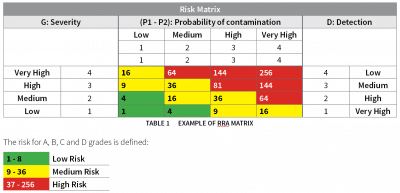
- Determine the Probability of Contamination. The probability of contamination is evaluated by two parameters, P1 and P2. Assigned values can range from 1 (low probability of contamination) to 4 (very high probability of contamination). The value depends on the probability of contamination associated with any risk situation.
- Use the FMEA method for the risk management methodology (example above). The aim is to detect the potential failures of TP (Total Particle) and Viable monitoring of the filling line and in the cleanroom. The risks are assessed by giving a score for each criterion: Severity, Occurrence, and Detection. Read the application note for more detail.
- Decide on your monitoring method. Particle Measuring Systems offers a wide range of non-viable and viable monitoring devices to use with every grade or cleanliness level.
Air Monitoring
In ISO 5/Grade A environments, risk is mitigated with the use of remote samplers. These samplers exhaust air outside the cleanroom using a central vacuum system. The use of mobile samplers with HEPA-filtered exhaust is preferred for Grade B, C and D areas. Click here for our list of particle monitors for air/aerosol.
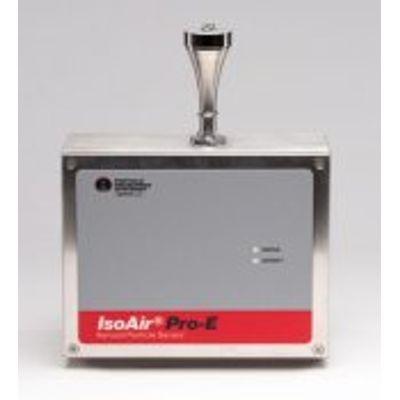
We recommend the IsoAir Pro-E Aerosol Particle Counter for remote sampling in cleanroom environments.
Surface Monitoring
It is better to use swabs in Grade A zones for surface monitoring instead of contact plates. When contact plates touch a surface, they leave culture media residue. This residue makes it difficult to validate a cleaning/sanitization method is able to remove the residue. Particle Measuring Systems can provide you with surface monitoring equipment in bulk to fit your needs.
The risk assessment is a collaboration of many people that takes time and dedication. Be sure to learn more about Particle Measuring Systems Advisory Services to know how Particle Measuring Systems can help you complete your analysis and start complying with regulations.