


- Home
- Companies
- Dispersion Technology, Inc. (DTI)
- Articles
- Ultrasound induced colloidal particles ...
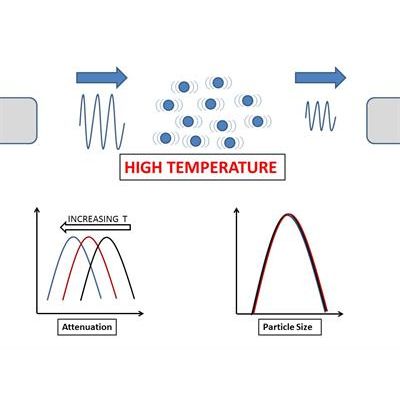
Ultrasound induced colloidal particles oscillation in liquid at elevated temperatures
Ultrasound attenuation spectroscopy provides a unique means for studying various properties of complexfluids such as aggregative stability, particle size, longitudinal rheology, zeta potential, etc. Additionally,ultrasound emerges as an important tool for microfluidics. These features of ultrasound attenuationspectroscopy are dependent upon a theory that describes colloidal particle motion in an ultrasoundfield. Here we verify experimentally the validity of this well-known theory at elevated temperatures.We measured the attenuation frequency spectra for a stable dispersion of alumina particles (300 nm)at different temperatures from 25◦C to 50◦C. Temperature variation affects water viscosity, which isa key parameter in said theory. We have demonstrated that the theory accounts for such dependenceaccurately, because critical hydrodynamic relaxation frequency shifts as the theory predicts, and particlesize calculated from the measured attenuation spectra remains constant over the complete temperaturerange.