

Unique geosynthetic clay liner system for uranium mill tailings disposal - Case Study
A uranium mill in the western United States uses sulfuric acid in the extraction process. The remaining byproduct is then stored in a tailings disposal cell. The liquids are acidic with a pH between 1 and 2.
Project Details
- Uranium Mill Tailings Disposal
Location
- Ores Processed in Utah, Colorado & Arizona
Products Used
- Bentomat ST
Challenge:
The liner system for the project must meet the Best Available Technology requirement, which states that the facility must be designed to achieve the maximum reduction of a pollutant achievable by available processes and methods.
Challenge:
The liner system for the project must meet the Best Available Technology requirement, which states that the facility must be designed to achieve the maximum reduction of a pollutant achievable by available processes and methods.
Solution:
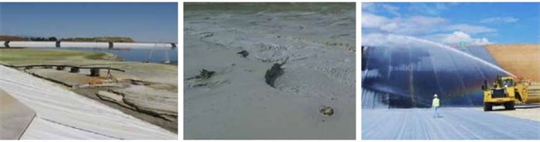
The primary liner consisted of a smooth 1.5 mm (60-mil) thick HDPE geomembrane due to its high resistance to chemical degradation and ability to withstand acidic environments. The secondary liner consisted of a composite liner that is comprised of a 1.5 mm thick HDPE geomembrane overlying a GCL. This provided an added hydraulic barrier against leakage to the subsurface soils and groundwater.
Although the GCL was used as an element of the secondary composite liner system, a testing program was devised to demonstrate that a GCL would exhibit low hydraulic conductivity when permeated with a low pH liquid similar to the process liquids anticipated to be contained by the liner system.
Testing consisted of permeating GCL samples with varying degrees of initial moisture content. Moisture contents varied from 50% to 140% and each sample was then permeated with a liquid pH of 1.0 under a normal stress of 5 psi, in accordance with ASTM D 6766, Scenario 1. The Action Leakage Rate (ALR) at 50% moisture was less than expected. Based on the test results and the ALR calculation of the head on the secondary liner, pore volume travel time through a GCL pre-hydrated to a moisture content of 50% was estimated to be more than 150 years for the first pore volume of permeant, which is well beyond the time when the cell will be drained of free liquids. Based on this analysis, the regulatory agency agreed that a minimum moisture content of 50% should be achieved in the GCL installed for this project.
Result:
The unique application of geosynthetic materials for the liner resulted in an effective and protective liner system that complies with the regulatory requirements while being very cost effective. Since the start of filling of the cell, the liner has performed well with minimal leakage detected in the leak detection system (significantly below the ALR).