


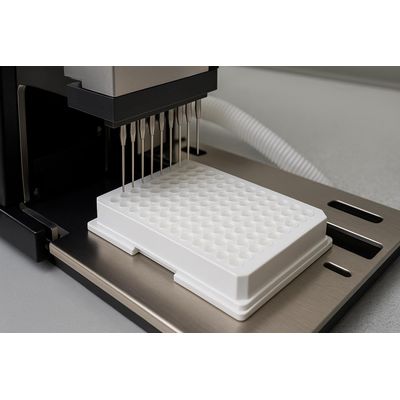
Why Your ELISA Plate Washing Step Deserves More Attention
ELISA plate washing is a critical determinant of assay performance. Residual liquid and carryover after washing can drive background signals, compressing the dynamic range and elevating the limit of detection.
Residual volume is the key variable. After aspiration-based washing, a small amount of liquid often remains in the well. That residual contains whatever you are trying to wash out. Even a few microliters can be enough to produce measurable signal when the detection enzyme is active.
Residual volume is rarely uniform. Corners and edges can behave differently because aspiration pins do not always sit identically in every well, and because plates are not perfectly flat.
Where conventional washers can struggle
- Carryover between wells: A pin that contacts liquid in one well can transfer a small amount to the next well.
- Aerosols and splashing: Aggressive aspiration and dispense settings can create droplets that move between wells.
- Cell detachment: In cell-based ELISAs, pin insertion can disrupt adherent layers.
How to evaluate your washer in one afternoon
- Residual volume test: Add a fluorescent dye, run the wash protocol, then read residual fluorescence to estimate how much liquid remains per well.
- Carryover plate: Alternate a high-concentration tracer with blanks and measure whether blanks pick up signal after washing.
- Uniformity map: Fill the plate uniformly and wash, then look for position effects that correlate with background.
Centrifugal washing as an alternative mechanism
Centrifugal washers remove liquid by spinning it out into an absorbent pad rather than aspirating through pins. Because no pins enter the wells, you remove a common carryover pathway and often reduce residual volume substantially.
As with any method, you still need to validate with your plate type, assay buffer, and incubation scheme. The point is that changing the physical mechanism can address issues that are hard to fix by tuning aspiration speed alone.
Key takeaways
- If ELISA background is stubborn, quantify residual volume instead of adding more wash cycles blindly.
- Carryover can be measured with a simple alternating plate design.
- When aspiration tuning hits a ceiling, a different wash mechanism can be the cleanest fix.