


- Home
- Companies
- Boyd Corporation
- Products
Boyd Corporation products
Engineered Materials - Gaskets and O-Rings
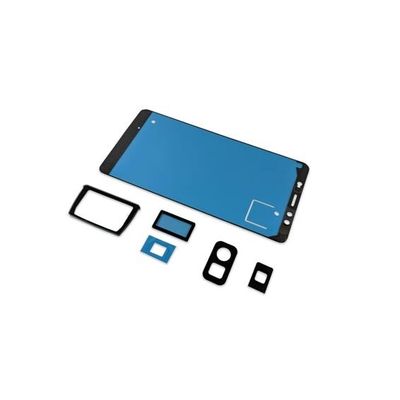
Gaskets and Seals
Gaskets and seals are components that are designed to prevent liquid, dust, debris, air, gas, EMI, light, chemicals or other items from entering or exiting a device. They are designed to fill the space between two imperfect mating surfaces, with the gasket or sealing material accommodating surface irregularities. A gasket or seal is generally made from a semi-resilient, conformable material that can have a number of highly specialized customizations optimized for the end product application. Material selection and gasket design relies on environmental conditions, compressive forces, mating surface finishes, material compatibility and temperature variations. Many applications utilize silicone foam gaskets due to their conformability, high material compatibility and versatility for a broad range of usage parameters.

Integrated Display Gasket
Electrical shielding, thermal spreading, vibration absorption & bonding display technologies in a streamlined solution. Advanced screen displays require additional components to help them perform more efficiently and last longer. These solutions, in the form of Integrated Display Gaskets, are composed of bonding systems, vibration management, optically clear adhesives (OCA), window tapes, barrier films and thermal management. Electronic display modules rely on the performance of every component within the screen assembly, including gaskets and cushions, which help protect against dust, moisture, shock, and vibration. Stable, innovative materials that hold ultra-tight tolerances are better able to seal against environmental and contaminant factors. This makes raw material selection the foundation of the longevity of the display module and thus the lifetime of the final product.
Thermal - Air Cooling
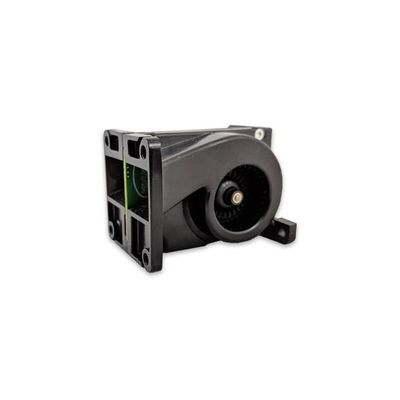
High Performance Air Cooling Solutions
Double Width Double Inlet (DWDI) Blowers are a high performance air cooling solution that offer different design options and power capabilities compared to fans or other blowers. DWDI Blowers can handle a greater pressure drop, which is ideal for use with high fin density heat sinks and heat exchangers for high performance cooling. Blowers generate air flow perpendicular to the inlet(s), allowing for more flexibility in housing geometry. This also enables more localized cooling and greater creativity in system design. These unique Double Width Double Inlet Blowers are designed to provide optimized cooling with minimized acoustics, allowing for active cooling systems that are four to eight decibels (dBA) quieter than comparable axial fan systems. Boyd’s engineering team also specializes in acoustic analysis, enabling us to refine the design of our DWDI housings and impellers to reduce tonal vibration and improve overall sound profile of these blowers.
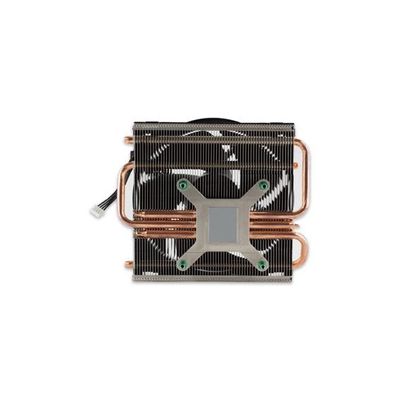
Fan Heat Sink Assemblies
Boyd Fan Heat Sink Assemblies are pre-assembled complete thermal solutions for a variety of board level applications. Save time and space while increasing thermal performance with these compact solutions that are ready to install. Impinging air flow from the fan enables the cool intake air to contact more fin surface area, improving thermal performance. Standard Boyd Fan Heat Sink Assemblies are comprised of a black anodized aluminum heat sink, an Boyd fan, attachment hardware, and thermal interface material. These drop-in solutions provide localized cooling to increase the performance and reliability of your FPGA/BGA device.
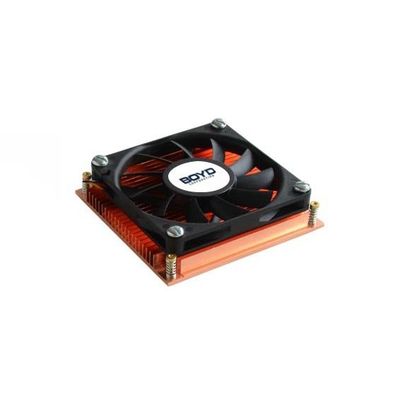
Axial Fans
Fans are the simplest and most cost-efficient method of increasing thermal performance. Adding a fan to a natural convection solution improves heat transfer by directing cooler air into, around and/or over primary thermal device, forcing heat and hot air out of an assembly. When ambient environment or natural convection cooling cannot sustain enough heat transfer for higher power applications, fans and forced air convection cooling are designed to manipulate this environment. Fans are used to maintain an optimized flow rate that allows maximum thermal transfer within designed specifications. Fans force cool air over a thermal component like a heat sink, heat pipe, or vapor chamber, enabling heat to transfer from the thermal component to the forced air, then transfer that heat out of an assembly.