


- Home
- Companies
- Bruker Corporation
- Products
- Raman Spectroscopy Solution
- Advanced Automation
- Mass Spectrometry - MALDI-TOF
- Diffractometers & Scattering Systems - Single Crystal X-ray Diffractometers
- Infrared, Near Infrared & Raman - FTIR Spectrometers
- DART
- DART-QDa for Waters Acquity QDa Detector - Consumables
- Innovative Mass Spectrometry Systems
- Molecular Vibrational Spectroscopy
- X-ray Diffraction and Elemental Analysis
- Magnetic Resonance
- Mobile Detection
- Surface Analysis
- Fluorescence Optical Microscopy
Bruker Corporation products
DART-QDa for Waters Acquity QDa Detector - Consumables
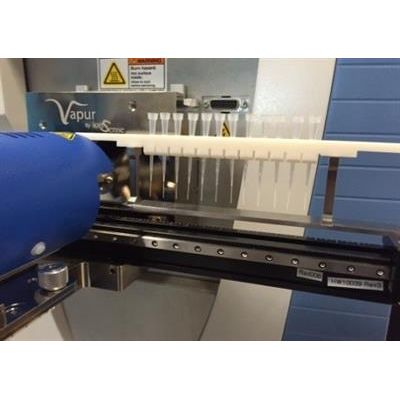
SPE-it - Tips for Solid Phase Microextraction Devices
SPE-it Tips are solid phase microextraction devices configured to permit isolation of analytes from aqueous solutions and then direct analysis without further sample processing. The fiber tips are SPME fibers embedded in a micropipette tip for easy handling. The fiber coating is composed of either. C18 or PDMS-DVB bonded silica particles embedded in a biocompatible polymer. Because the tips are commonly used with biological fluids, it is recommended that each tip only be used for one sample. The tips can be manipulated manually or by robotic equipment. The SPE-it tips are shipped in a 96-well format tray.
QuickStrip - Model 96 - Sample Cards
Our newest consumable is designed to permit sampling with auto-pipettors and robotic sample pipetting systems such as the Apricot Design iPipettor. In this workflow samples prepared as liquids in a 96-well plate are positioned on the sampling stage of the robotic pipetting station. The metal frame used to transport and hold the QS-96 in position mounts on top of a flattening stage which pushes the wire mesh against the frame making the distance between the pipette tips and QS-96 uniform. An accurate volume of sample is deposited onto each of the discrete screen positions. The sample is left to dry in the metal frame and then positioned on the robotic sample arm of the DART-HT for high throughput desorption ionization and MS analysis.