


- Home
- Companies
- Cascade Drilling
- Products
Cascade Drilling products
Drilling
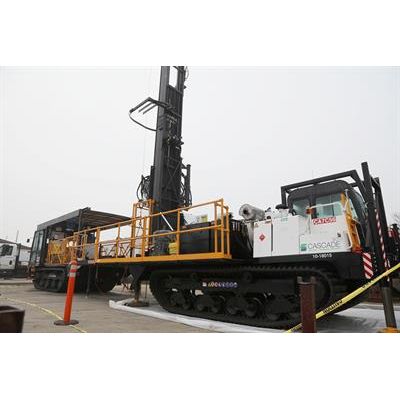
Cascade - Sonic Drilling Rig
Sonic technology is ideal for both deep and shallow drilling applications where undisturbed core sampling through almost any type of geological formation is required. This powerful technology provides many advantages over other types of drilling techniques. It is a low-impact technology that is safer by minimizing crew tool handling. By rotating and vibrating the rod, core barrel, and casing at sonic frequencies a clean borehole is drilled, cored, and cased at the same time. A great deal less cuttings are generated, saving time and money. Continuous cores are produced using a single tube core barrel and an override casing.
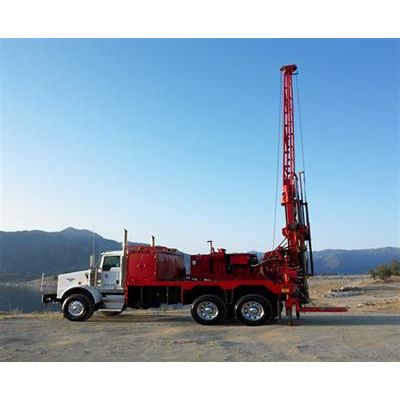
Cascade - Hollow Stem Auger Drilling Rig
Hollow stem auger drilling is a proven and relatively inexpensive technique for a wide range of environmental and geotechnical applications including: sampling, installation of monitoring wells and data collection instruments, and subsurface improvements. Hollow stem auger drilling employs flighted tubing (augers), a cutter head and rotation to advance through the formation and remove the drill cuttings. Different cutter head designs can be utilized based on geology. Soil samples are easily obtained by lowering and advancing a variety of different sized split spoon samplers through the hollow stem augers and out in front of the bit face.
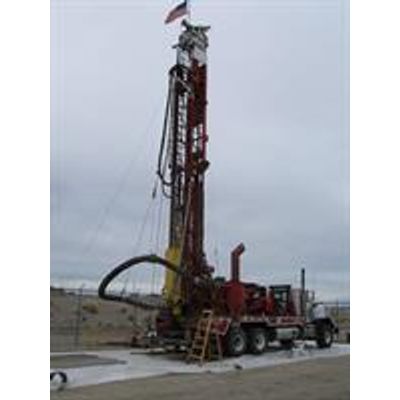
Cascade - Rotary Core Drilling Bit
Rotary technology uses a sharp, rotating drill bit and downward pressure to cut, or crush, through the subsurface. Impact energy is supplied to the drill bit from either an above ground or down hole impact hammer. This impact force aids in the drilling. Depending on the competency of the substrate, the drill casing is advanced as the hole is cut, keeping the hole open during drilling. Competent rock may be drilled "open hole", not requiring the use casing..
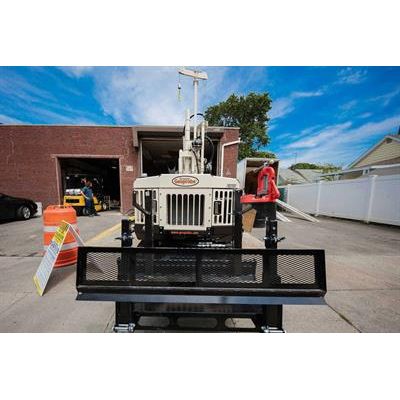
Cascade - Direct Push Technology
Direct push technology, often referred to as DPT, uses the static weight of the rig combined with a hydraulic hammer to advance tooling or instrumentation through the subsurface. Unlike rotary, the drill cuttings are not removed from the hole. The speed and depth of penetration is largely dependent on the soil type, the size of the sampler, and the weight and power of the rig. These systems can be used to perform subsurface soil, water or vapor surveys. They are capable of obtaining soil and groundwater samples, installing standard and pre-packed monitoring wells, and have geotechnical capabilities when equipped with 140 lb. hammer. They can drill and set piezometers, inclinometers, and vapor points; and support injection of a variety of remediation compounds.
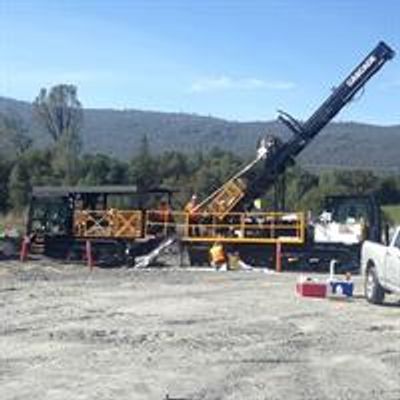
Cascade - Diamond Core Drilling Bit
Diamond core drilling is a common technique in the mining industry for extracting core samples. It is ideal for geotechnical work in semi-consolidated/cemented rock to hard rock environments. Downward pressure and high rotation rates advance drill bits that are faced with diamond impregnated steel. Down pressure and fluid circulation are carefully monitored during drilling. Rock core samples are typically returned using an efficient wireline system. There is a wide selection of drill bits to choose from based on rock types and core sizes. Cascade typically uses a wireline coring system for hard rock applications to obtain core samples and Rock Quality Designation (RQD).