

Environmental Leverage Inc. services
Filamentous Identification Analysis & Training
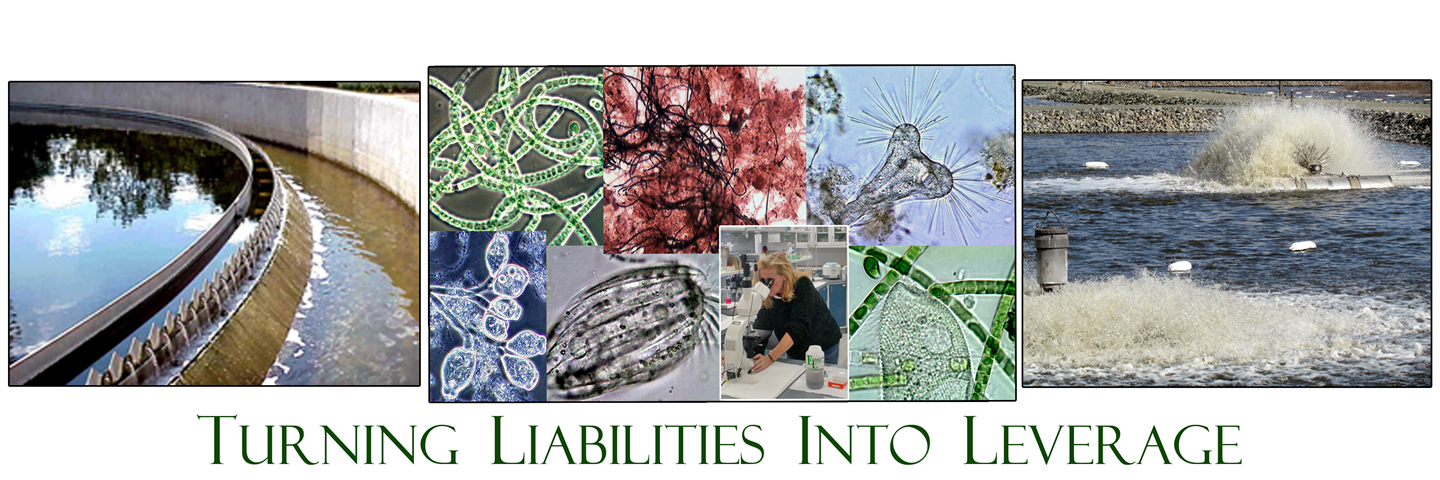
I don`t have filaments at my plant!!! You might want to check again. A common misnomer in many waste water treatment plants is that unless they have filaments that are bridging and they can see them between the floc structures, they do not have filaments. In reality, internal bulking can cause more problems than slight bridging. Many plants think there is only a problem when they have external filaments that are causing bulking problems. In reality there are three ways to cause bulking at a plant, internal filaments, external filaments or non-filamentous bulking- which can be caused by Zooglea, fungi and in many municipalities or paper mills, fiber or tissue.
Wastewater Biomass Lab Analysis
Microscopic analyses of any biological system should be a critical component of any ongoing daily monitor and control programs. Lab sheets to correlate health of the system, any changes in floc structures, higher life forms, filamentous identification, polysaccharide coating of the bacteria and suspended solids can be determined by using a microscope and examining the biomass. This is a tool that can help not only show exactly what the health of the system is at a given time, but can also help predict which direction the plant is headed if used daily. It is a tool that can also help prevent critical upsets, or be used as an early warning. In the cases of filamentous problems, staining and identification of the filamentous can help with troubleshooting and help avoid costly chemical consumption.
Cooling Tower Microbiological Water Laboratory Analyses
Cooling towers can be a critical process in many industrial production facilities. An industrial cooling tower can be the perfect media for biological growth if not properly treated. Typical pH is 7-9 and temperatures may have a wide range. In a cooling tower, the water trickles down a large surface area in order to air-cool the water. The natural evaporation provides the cooling necessary to reuse the water. As water evaporates, minerals and contaminants in the water concentrate. These minerals and contaminants will eventually reach a concentration where they will cause problems and interfere with the performance of both the tower and the cooling system, itself. Fouling and corrosion of the cooling tower can impact treatment, and impact heat transfer losses causing decrease in efficiency and increased power consumption.
Microscope Bacterial Slides Set
We have just added `Virtual Audits` to our capabilities. Check out our new Services. We are in the process of developing an ``Online E-University` in order to meet the needs of our global customers that cannot travel to our public classes. Stay tuned for details and updates. We have been asked by numerous customers to sell them some of the slides we used in our hands on Filamentous Identification training classes. So we created a new item for you to practice at home yourself. It is one thing to look at photos of Gram and Neisser stains, it is another to try to find the filaments on a stain. They do not always pose and sit still for you. Also, we tend to `crop` the photos we take so that you can focus on just the filaments we are demonstrating. So, we created a set of Microscope Gram and Neisser slides. There are 10 sets from 10 different plants. Each slide can be used again and again for practice. The slides are labeled with the major filaments present.
Onsite WWTP Audits & Training
Onsite Troubleshooting and Audits. Industry and municipal wastewater treatment plants. The audits consist of full operations from front to back of your WWTP. Operating data from wastewater treatment plants can be generated to include some useful operational control strategies.