
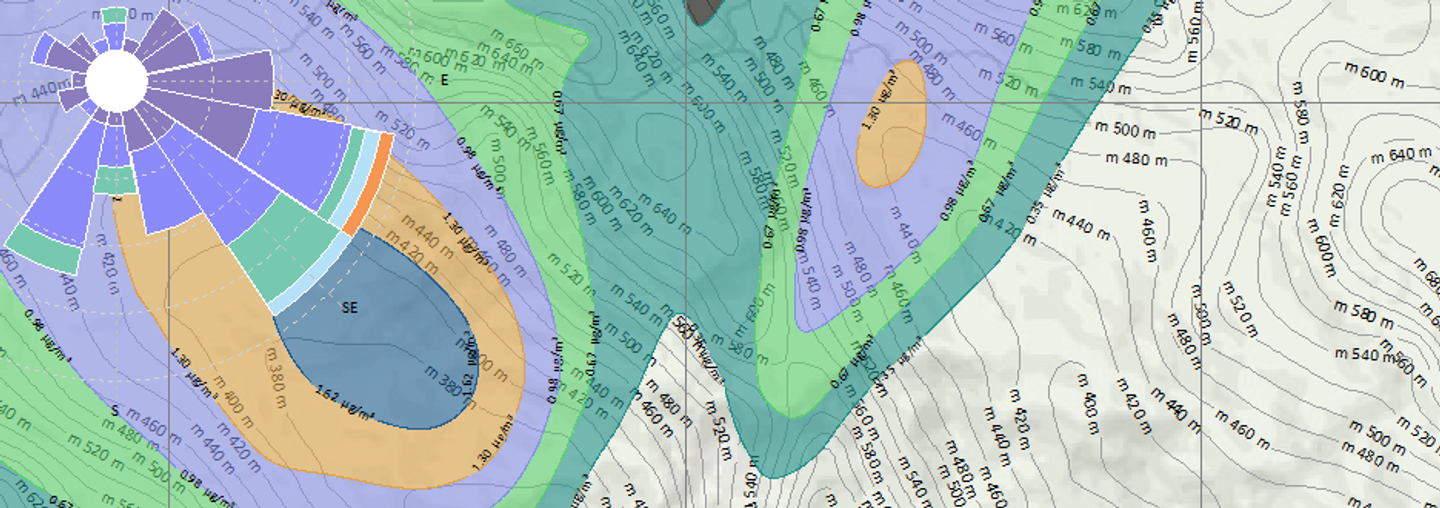

Envitrans Private Limited software
Air Quality Software
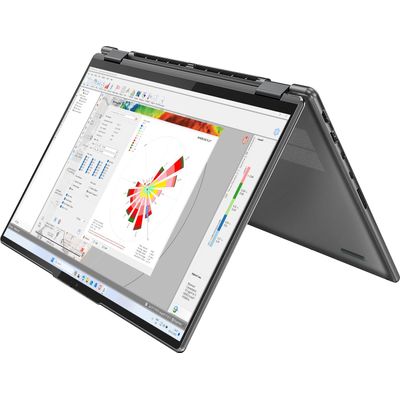
AERMOD Cloud - Air Dispersion Modelling Software
Air Dispersion Modelling predicts how pollutants are dispersed in the atmosphere from different pollution sources taking into account building influences, topography, meteorology, downwind distances, and other factors. Air Dispersion modelling is a mathematical simulation of how air pollutants disperse in the ambient atmosphere. The simulation uses mathematical equations and algorithms to characterize the atmospheric processes that distribute an air pollutant emitted by a source over a wide area. These models are used to estimate or to predict ground level concentrations (GLC) at selected downwind receptor locations of air pollutants emitted from sources such as industrial plants, mines, vehicular traffic or accidental chemical releases.

CALINEpro - Traffic Emissions Dispersion Model
CALINEpro is based on steady-state Gaussian plume models specifically designed to calculate air quality impacts from vehicle emissions near highways. Given source strength, meteorology and site geometry, the model can predict pollutant concentrations for receptors located within 500 meters of the roadway. It also has special options for modelling air quality near intersections, bridge and parking facilities.
FDMpro - Model 1.2 - Fugitive Dust Emissions Modeling System
FDMpro™ is an air quality model specifically designed for computing concentration and deposition impacts from fugitive dust sources. The model is based on the concept of US EPA Fugitive Dust Model (FDM) and CALINE. It can be used to model non-buoyant point, line and area sources. The model is generally based on the well-known Gaussian Plume formulation for computing concentrations, but the model has been specifically adapted to incorporate an improved gradient-transfer deposition algorithm.
dhwaniPRO - Noise Modeling Software
Envitrans is pleased to announce the release of dhwaniPRO an ambient air noise modeling application developed for the professionals working with environmental impact assessment of noise pollution scenarios. Noise modeling includes industrial and traffic noise.