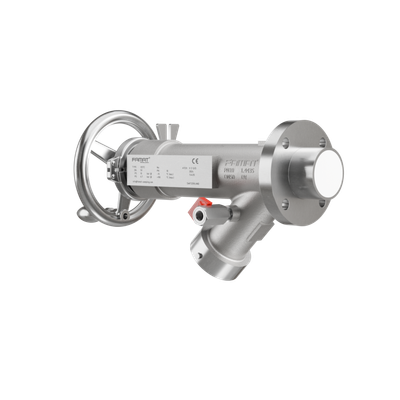
FAMAT Sampling System products
Sampling Valves - DN50
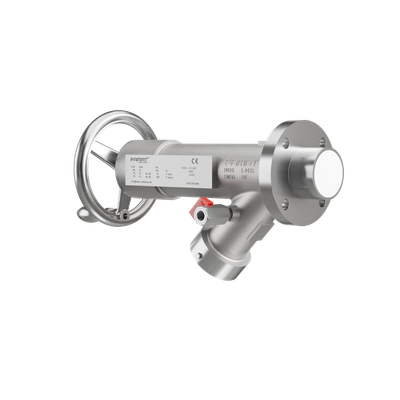
Famat - Model Type 125A Standard - DN50 Sampling Valve
The DN50 Sampling Valve Model 125A is designed for precision sampling tasks, offering reliable performance in various applications. With a nominal size of DN 50 (2 inches), it operates under a pressure class of PN10, managing pressures from vacuum to 10 bar (0-145 psi). Its temperature range extends from -10°C to +180°C (-14°F to +356°F), ensuring adaptability in diverse conditions. The valve's body is constructed from robust materials such as stainless steel (1.4435/04/316L), Hastelloy® (2.4602/C22), and Titanium (Grade 7), supporting rigorous sampling needs. The seals are crafted from Viton, FEP-Viton, Perfluoroelastomer FFKM, and EPDM, all FDA-compliant. The valve's internal roughness measures Ra ≤0.8 µm, with optional polishing available, while the external roughness is Ra ≤3.2 µm. It includes a 150 ml sample unit made of borosilicate glass with stainless steel protection. Compliance with 2014/68/UE (PED), 2014/34/UE (ATEX), and FDA standards underscores its engineering quality.
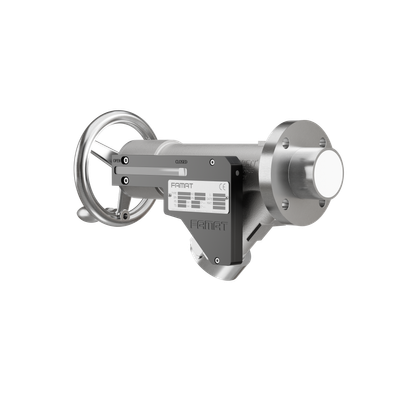
Famat - Model 125S - Sampling Valve for DN50 Applications
The 125S Sampling Valve is designed for precise and reliable sampling in fluid systems, particularly for DN50 pipelines. Capable of withstanding pressures from vacuum conditions up to 10 bar (0-145 psi) and operating within a temperature range of -20°C to +180°C (-4°F to +356°F), this valve accommodates a wide array of industrial environments. Constructed from robust materials including stainless steel (1.4435/04/316L), Hastelloy® (2.4602/C22), and Titanium (Grade 7), it ensures durability and resistance to corrosion. The valve features seals made from Viton, FEP-Viton, and FDA-approved materials like Perfluorelastomer FFKM and EPDM, making it suitable for critical sampling tasks. The internal surface roughness is Ra ≤0.8 µm, offering a smooth finish, while the external is Ra ≤3.2 µm, with additional polishing available. The sampling unit comprises a 150 ml bottle manufactured from stainless steel with glass sight windows, allowing clear observation of the sample.