


- Process Engineering - Mechanical Process Engineering - Separation Methods:Classifying and Sorting
- Mechatronics - Engineering Drawing - Geometric Models
- Thermal Engineering - Fundamentals of Thermodynamics - Thermodynamic State Variables
- HVAC - Heating Ttechnics - Principles of Heating
- HVAC - Heating Ttechnics - States of the Air
- Fluid Mechanics- Physical Principles - Properties of Fluids
- Fluid Machinery - Driving Machines- Thermal Turbines
G.U.N.T. Gerätebau GmbH products
Process Engineering - Mechanical Process Engineering - Separation Methods:Classifying and Sorting
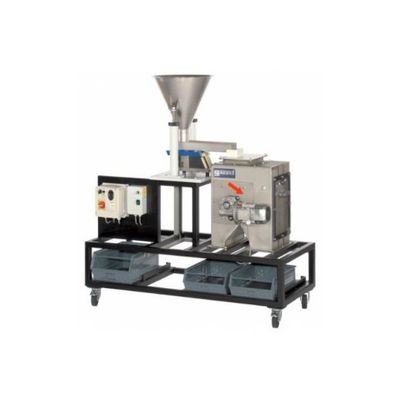
Gunt - Model CE 280 - Magnetic Separation Machine
During sorting, a solid compound is separated according to its material characteristics. Magnetic separation is a method of sorting which utilises the magnetisability of components of a solid compound. Magnetic separators are often used in coal and ore preparation. In the CE 280, the solid compound to be separated is charged into the feed hopper. A vibrating trough conveys the compound onto a rotating, non-magnetic drum. Its speed can be adjusted by way of a potentiometer. In one area of the drum there is a fixed permanent magnet. Non-magnetisable components drop into a collector tank due to gravity. Magnetisable components adhere to the drum in the area of the magnet, are carried along and drop into a different tank as soon as they are beyond the magnetic zone.
Mechatronics - Engineering Drawing - Geometric Models
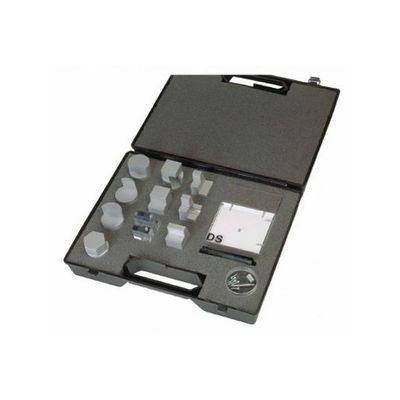
Gunt - Model TZ 100 - Three-Dimensional Display System
In order to describe a spatial body adequately and thereby fulfil a basic principle of exact replication and repeatable production, several views of the body are usually necessary. To do this, bodies are shown in three planes: front view, side view and plan or bottom view. The presentation follows fixed rules that are defined in the standards. Even for simple bodies, the presentation in three planes requires a considerable degree of abstraction ability and spatial imagination on the part of students. This ability is a prerequisite for both creating and interpreting engineering drawings or sketches and is taught by means of geometric models.
Thermal Engineering - Fundamentals of Thermodynamics - Thermodynamic State Variables
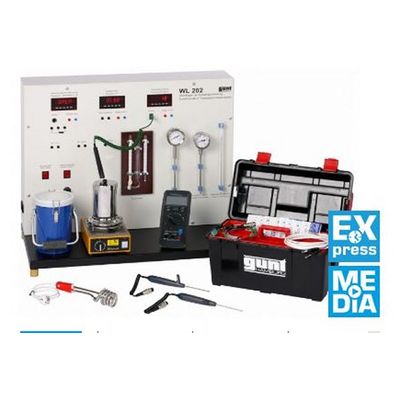
Gunt - Model WL 202 - Temperature Measurement System
Recording temperature is one of the basic tasks in metrology. Electric temperature sensors are the most widely used in automation applications but conventional thermometer types are still widely applied in many areas. The WL 202 experimental setup covers the full range of temperature measurement methods. As well as non-electrical measuring methods, such as gas- and liquid-filled thermometers and bimetallic thermometers, all typical electric measuring methods are covered in the experiments. The electrically measured temperatures are displayed directly on programmable digital displays. A temperature-proportionate output voltage signal (0…10V) is accessible from lab jacks, enabling temperature characteristics to be recorded with, for example, a plotter.
HVAC - Heating Ttechnics - Principles of Heating
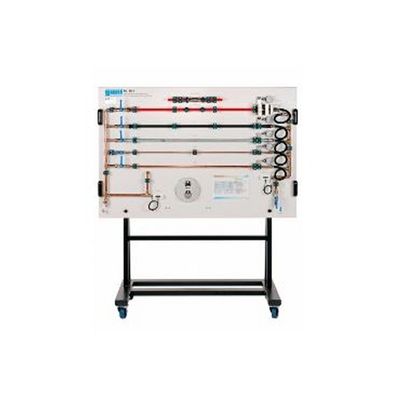
Gunt - Model HL 101 - Thermal Expansion Training Panel
The trainer comprises original components as used in heating and sanitation systems and is therefore relevant in practice. There are five expansion sections. In one of the sections, a compensator can be inserted. The elongation of the pipes is indicated on dial gauges. A force measuring device enables the expansion force to be determined.
HVAC - Heating Ttechnics - States of the Air
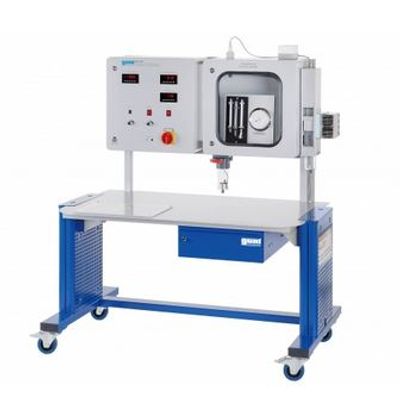
Gunt - Model WL 201 - Humidity Measurement System
The measurement of air humidity plays an important role in many branches of industry, e.g. during drying or in the air conditioning of buildings and vehicles. There are different measuring methods to determine humidity. The trainer WL 201 enables the measurement of air humidity with four different instruments which can be directly compared to each other: two different hygrometers, a capacitive hygrometer and a psychrometer. Psychrometers operate based on the principle of evaporation cooling and compare the ambient temperature with the wet bulb temperature to determine the humidity. Hygrometers utilise the property of specific fibres, e.g. hair, to expand with increasing air humidity. In the capacitive sensor the dielectricity constant of a layer and with it its capacity changes due to the water molecules absorbed.
Fluid Mechanics- Physical Principles - Properties of Fluids
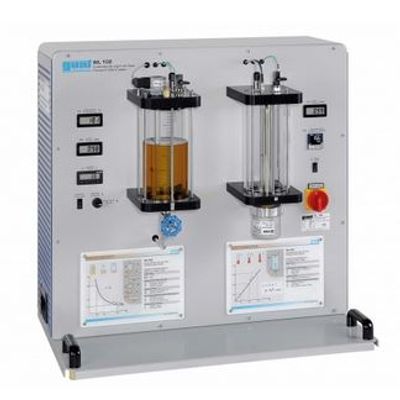
Gunt - Model WL 102 - Experimental Unit
Gas laws belong to the fundamentals of thermodynamics and are dealt with in every training course on thermodynamics. The WL 102 experimental unit enables two changes of state to be studied experimentally: isothermal change of state, also known as the Boyle-Mariotte law, and isochoric change of state, which occurs at constant volume. Transparent tanks enable the change of state to be observed. Air is used as the test gas.
Fluid Machinery - Driving Machines- Thermal Turbines
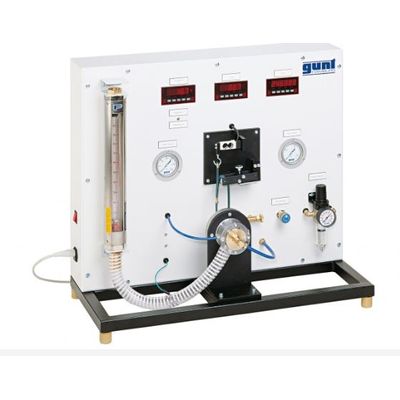
Gunt - Model HM 272 - Reaction Turbine
In reaction turbines, the static pressure of the working medium in front of the rotor is higher than that behind it. In pure reaction turbines with a degree of reaction of one, the entire pressure energy in the rotor is converted to kinetic energy. This compressed-air driven experimental unit can be used to understand turbines powered by steam or water.