


- Home
- Companies
- MagQu LLC USA
- Products
MagQu LLC USA products
Desktop Devices
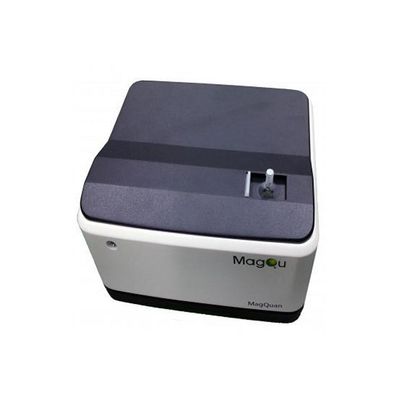
MagQu - Model MagQuan - Magnetic Concentration Analyzer
Currently the instruments used to measure the magnetic concentration are either of vibration sample magnetometer, SQUID magnetometer, or inductively coupled plasma-mass spectrometer. However, these analyzers are very expensive and high maintenance costs. We specifically developed this Magnetic Concentration Analyzer (MagQuan) to measure the magnetic concentration of samples within three minutes. MagQuan is very suitable for material development and quality control. The analyzer (MagQuan) obtains magnetic concentration of the sample by the measurement of alternative-current (AC) magnetization.
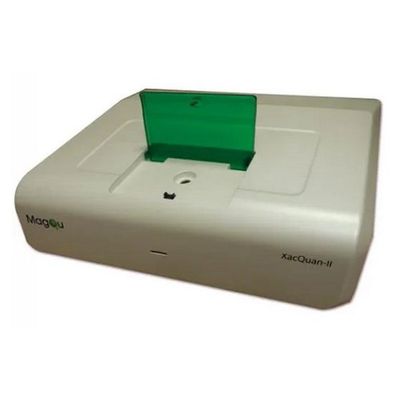
MagQu - Model XacQuan - AC Susceptibility Analyzer
Under an external magnetic field, the direction of magnetic dipoles of a magnetic substance tends to be along the direction of the external magnetic field. If the external magnetic field is an alternative-current (AC) magnetic field with low AC frequency (generally lower than microwave frequency), the magnetic dipole oscillates with this AC magnetic field with phase delay. The phase delay drivers the susceptibility into a complex number. XacQuan is a good device to measure the AC susceptibility and usually is also a good device to measure the magnetic concentration of magnetic materials.
IMR Analyzer
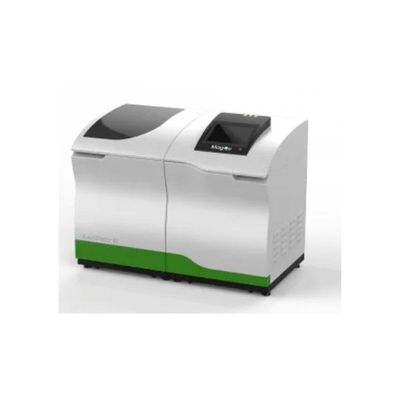
MagQu - Model XacPro-S - SQUID-Based Immuno-Magnetic Analyzer System
The magnetic immunoassay analyzer (Model: XacPro-S) created by MagQu Co., Ltd. is used to measure the change in the ac magnetic susceptibility of a sample over time. If a sample is mixed with our IMR reagent, the concentration of bio-molecules can be measured in correlation with the change in the ac magnetic susceptibility of the mixture. XacPro-S can be applied to molecular detection not only for research, but also for clinical diagnosis and field trials. Potential target bio-molecules include proteins, viruses, nucleic acids , bacteria, and even small molecular compounds.
IMR Reagents
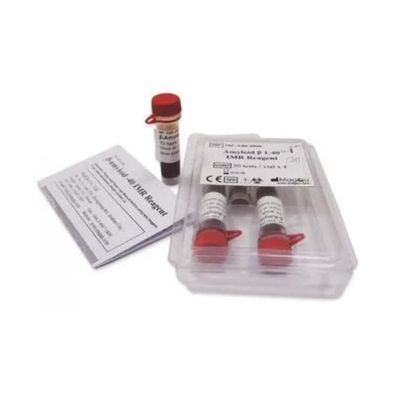
Model MF-AB0-0060 - Amyloid ß 1-40 IMR Reagent
The Amyloid β 1-40 (Aβ1-40) IMR Reagent is used to quantitatively measure Aβ1-40 protein in human fluid specimen, such as plasma. Use Aβ1-40 IMR Reagent only with the XacPro-S System (MagQu Co., Ltd.). Amyloid β (Aβ or Abeta) denotes peptides of 36–43 amino acids that are crucially involved in Alzheimer`s disease as the main component of the amyloid plaques found in the brains of Alzheimer patients. The peptides result from the amyloid precursor protein (APP), which is being cut by certain enzymes to yield Aβ. One of the most common isoforms is Aβ1-40.
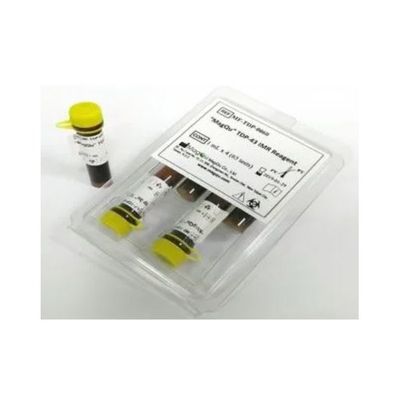
Model MF-TDP-0060 - TDP-43 IMR Reagent
TDP-43 is a neuronal protein that is implicated in the presence of neurodegenerative diseases. The “MagQu” TDP-43 IMR reagent is designed for quantifying TDP-43 protein by Immuno Magnetic Reduction (IMR). We conjugate antibody on the surface of around 50 nm-in-diameter Fe3O4 magnetic particles. When the antibodies on the surface bind with TDP-43 protein, the magnetic particles form clusters. Therefore, the ac susceptibility (Xac) of magnetic particles would be reduced in the applied ac magnetic field. By measuring the reduction of Xac, we can quantify TDP-43 protein in the sample easily and accurately.4,5
Beads & Separator Products
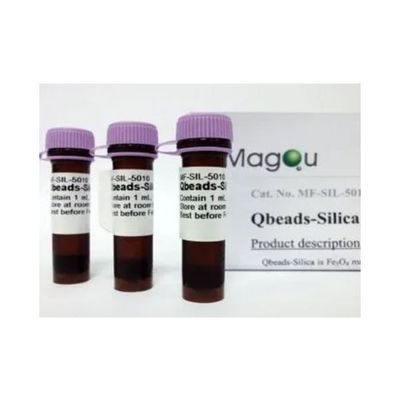
Model MF-SIL-5010 - Qbeads-Silica Fe3O4 Magnetic Beads
Qbeads-Silica is Fe3O4 magnetic beads coated with a silicon dioxide (SiO2) layer. Since silica is able to bind to the nucleic acids, Qbeads-Silica serves as simple and efficient tool for plasmid DNA purification for transfection or sequencing applications, genomic DNA purification for research or clinical applications, RNA purification for qPCR analysis, or PCR product clean-up for downstream analysis. For this product (MF-SIL-5010), it is a bead with high magnetic and fast sedimentation. If you need a bead with high adsorption and high suspension, you can use related Magqu product, MF-SIL-5024.
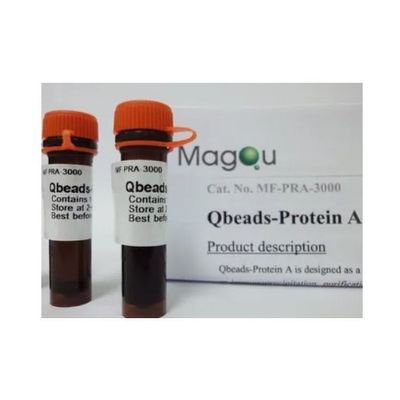
Model MF-PRA-3000 - Qbeads-Protein A
Qbeads-Protein A is designed as a rapid and simple tool or immunoprecipitation, purification/ depletion assays, and other magnetic separation applications. Antibody can easily bind to the Qbeads due to its’ high affinity with protein A. Via the antibody specific binding ability, the target protein along with Qbeads-Protein A could be temporarily immobilized at tube wall, so the other parts in the supernatant can be removed easily and efficiently under magnetic attraction.
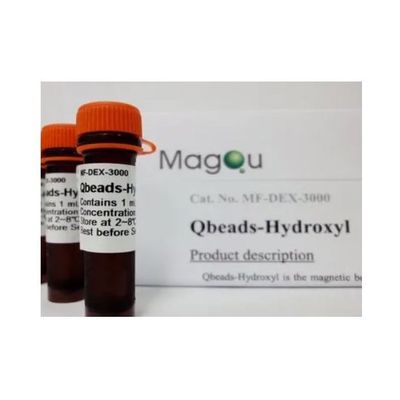
Model MF-DEX-3000 - Qbeads-Hydroxyl
Qbeads-Hydroxyl is the magnetic bead with hydroxyl groups -OH. The magnetic beads consist of single-crystal Fe3O4 sphere core coated with dextran dispersed in PBS solution. The structure of dextran provides a lot of hydroxyl groups –OH and this hydrophilic surface ensures the magnetic beads excellent dispersion ability and easy handling property in a wide variety of buffers. The beads are available for you to achieve rapid and efficient biomagnetic separation and ensure reliable and reproducible results.