


Molecular Knowledge Systems, Inc. software
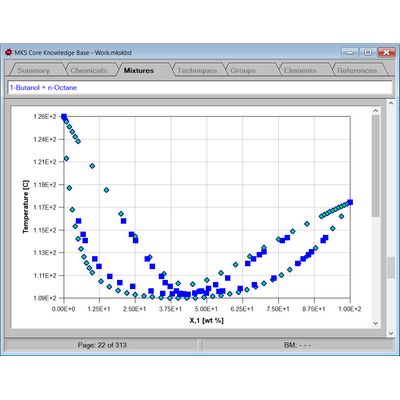
MKS - Model CRANIUM - Chemical and Mixture Physical Property Estimation Software
Cranium is a software package dedicated to estimating the physical properties of chemicals and mixtures, crucial for scientific and industrial applications. Users can input molecular structures directly or import them from other chemistry software tools, simplifying the estimation process. To estimate properties, Cranium employs an advanced set of Applicability and Accuracy rules, selecting optimal estimation techniques for over 30 physical attributes. The platform caters to both new chemicals and mixtures, offering flexibility in data input with options like mole fraction, mole percent, weight fraction, and weight percent. It automatically handles concentration conversions, aiding in accurate assessments. For complex estimation tasks, Cranium features recursive techniques to derive necessary data input values, utilizing boiling point, critical temperature, and pressure where needed. Export capabilities allow seamless integration with process simulators, analytical tools, and other chemical software solutions. Consistently updated with emerging estimation techniques, Cranium remains at the forefront of its field, offering four distinct editions tailored to diverse user needs.
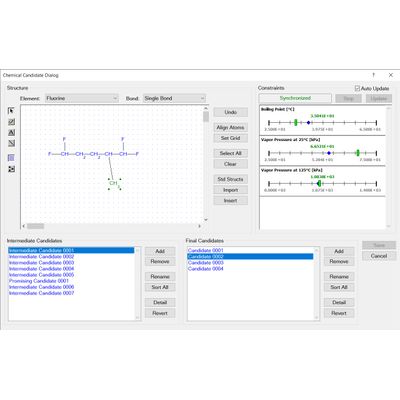
MKS - Model SYNAPSE - Chemical Product Design Software
Synapse is a cutting-edge chemical product design software tool that revolutionizes the way molecules and formulations are designed to meet desired physical properties. By allowing users to input specific design constraints, such as azeotropic conditions, solubility limits, volatility, and flash points, Synapse generates thousands of candidate molecules through computational molecular assembly. Each potential molecule is evaluated against the defined constraints, ensuring that its properties fall within the specified ranges. Synapse's design capabilities include both graphical and combinatorial approaches, allowing users to either manually draw or automatically generate potential molecular structures. These design groups can be substituted into molecular structures, offering flexibility and control over the final product's chemical characteristics. This software facilitates the exploration of new chemical spaces for applications ranging from solvents to fragrance chemicals, enabling designers to innovate while adhering to environmental and toxicity standards.