


Optoplex Corporation products
Optical Phase Demodulators
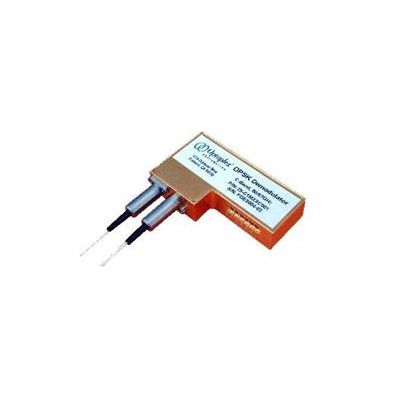
Optoplex - Model DPSK - Demodulator / Delay Line Interferometer
Optical differential-phase shift keying (DPSK) provides a desired modulation format that offers high receiver sensitivity, high tolerance to major nonlinear effects in high-speed transmissions, and high tolerance to coherent crosstalk. In DPSK, data information is carried by the optical phase difference between adjacent bits. For direct detection of DPSK signal (by conventional intensity detectors), a DPSK demodulator is needed to convert the phase-coded signal into an intensity-coded signal.
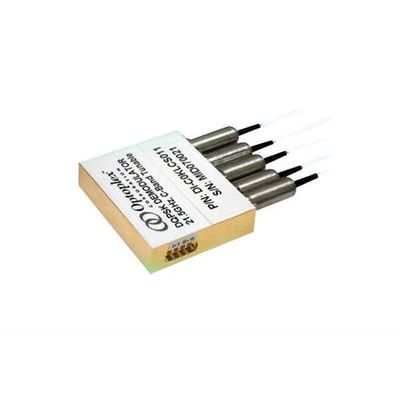
Optoplex - Model DQPSK - Demodulator
Differential Quaternary Phase-Shift Keying (DQPSK) is the four-level version of DPSK. DQPSK transmits two bits for every symbol (bit combinations being 00, 01, 11 and 10) and has an additional advantage over conventional binary DPSK. DQPSK has a narrower optical spectrum, which tolerates more dispersion (both chromatic and polarization-mode), allows for stronger optical filtering, and enables closer channel spacing. As a result, DQPSK is the only modulation format which allows processing of 40Gb/s data-rate in a 50-GHz channel spacing system.
Optical Interleavers
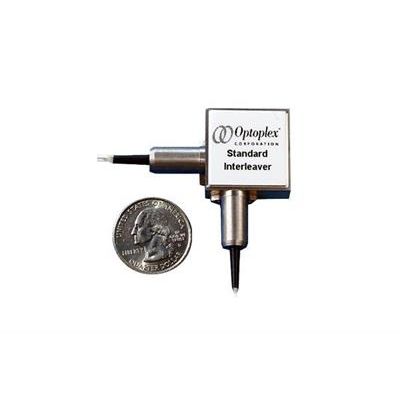
Optoplex - Standard Optical Interleaver
An innovative technique for expanding the number of channels per fiber involves an optical device, called an optical interleaver. For example, in most DWDM equipment, the standard channel spacing is 100 GHz. But spacing the signal-carrying frequencies every 50 or even 25 GHz can double or even quadruple the number of channels per fiber. This job is accomplished by an optical interleaver. Such a device takes two multiplexed signals with 100-GHz spacing and interleaves them, creating a DWDM signal with channels spaced 50 GHz apart. The process can be repeated, creating even denser composite signals with 25-GHz or 12.5-GHz spacing. The signals at the receiving end are recovered with the same devices used as splitters or optical de-interleavers. Thus, devices and/or networks can be upgraded without requiring that all devices be upgraded, or network bandwidth can be increased.
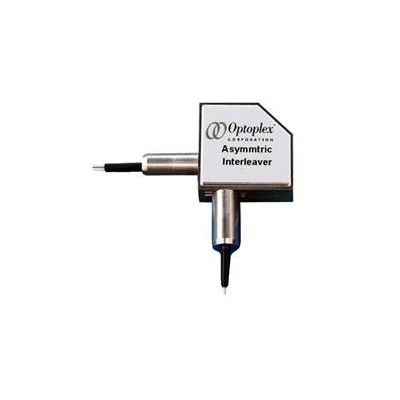
Optoplex - Asymmetric Optical Interleaver
Conventional Optical Interleaver is Symmetric Optical Interleaver. By "Symmetric" we mean that both "Odd" and "Even" channels have the same passband widths and waveforms. Optoplex offers a new type of Optical Interleaver whose "Odd" and "Even" channels have different passband widths and waveforms. This is FlexSlicer™ Asymmetric Optical Interleaver.
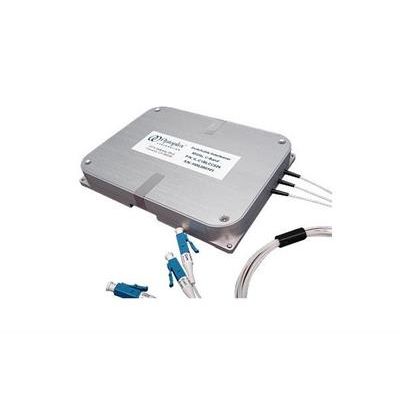
Optoplex - Switchable Optical Interleaver / De-Interleaver
In a switchable interleaver, there are two operation modes: Mode A: All pass, Mode B: Interleaver. In Mode A, the system operates at any channel spacing, in which all channels pass through the device and output from one of the two output ports as if there is no extra device inserted. When the system is switched to Mode B, the device operates as a normal optical interleaver, such 50-100GHz interleaver.
Tunable Optical Filters
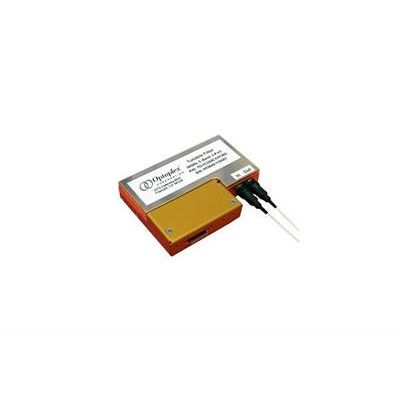
Optoplex - 2-Port Optical Tunable Filter
Optoplex`s Tunable Optical Filter, also known as Optical Tunable Filter or Tunable Bandpass Filter, is an integrated module, consisting of micro optics and electronics. When receiving a stream of optical signals of a plurality of wavelengths from the Input-Port (IN), the 2-port tunable optical filter directs a selected channel to the Output-Port (OUT). The selected channel can be varied (tuned) within the operating wavelength (frequency) range by a remote command sent through the built-in control PCB and firmware.
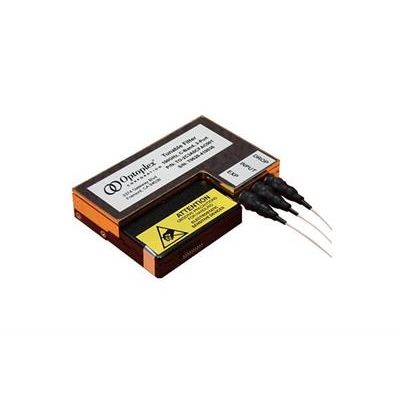
Model ROADM / TOADM - 3-Port Reconfigurable Optical Add/Drop Multiplexer
Optoplex`s Reconfigurable Optical Add/Drop Multiplexer (ROADM) module, also known as Tunable Optical Add/Drop Multiplexer (TOADM), is based on a proprietary micro-optics and micro-actuator design, athermal packaging technology, and state-of-the-art thin-film coating. When receiving a stream of optical signals of a plurality of wavelengths from the Input-Port (IN), this 3-port ROADM device directs a selected channel to the Drop-Port (ADD/DROP) and the remaining channels to the Express-Port (EXP), as depicted in the figure below. This tunable feature can also be used for adding a channel, when the device is used in reverse. Cascading two ROADM modules, simultaneous add and drop functions can be achieved. Each single ROADM device is optimized to cover either C- or L-band wavelengths. The standard 100- or 200-GHz channel spacing ROADM products allow for single-channel drop. Customized banded-channel drop ROADMs are available upon request.
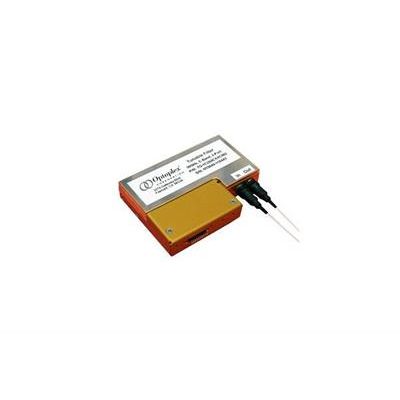
Tunable Edge Filters
Tunable edge filter is a customized product. It usually belongs to 2-port optical tunable filter product platform. Instead of using narrow bandpass filter in the 2-port tunable optical filter, the tunable edge filter utilizes a low-pass or long-pass interference filter. By changing the incident angle of the light beam, the cut-off wavelength will be tuned. Standard Tunable edge filters support C-band or L-band wavelength range. In other applications, Tunable edge filter can be in 3-port configuration, in which one output is long pass and the other one is low pass.
Optical Monitors
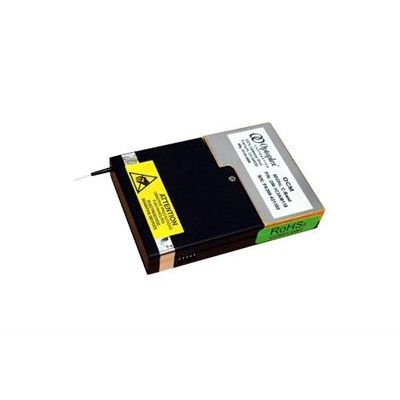
Optoplex - Optical Channel Monitor (OCM)
Optoplex Optical channel monitor (OCM) uses proprietary thin-film interference filter technology combined with a micro-actuator and high-speed electronics. Optical channel monitor is used to measure critical information data on optical transmission signals in DWDM networks for monitoring signal dynamics, determining system functionality, identifying performance change, and providing feedback for controling network elements so as to optimize operational performance. In particular, Optoplex Optical channel monitor can automatically scan the C-, L- or C+L-band wavelength range and precisely measure channel wavelength, power, and optical signal-to-noise ratio (OSNR). See the following schematic diagram for OCM working principle.