


Optoplex Corporation products
Optical Interleavers
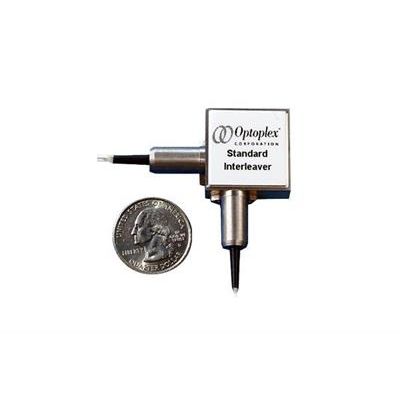
Optoplex - Standard Optical Interleaver
An innovative technique for expanding the number of channels per fiber involves an optical device, called an optical interleaver. For example, in most DWDM equipment, the standard channel spacing is 100 GHz. But spacing the signal-carrying frequencies every 50 or even 25 GHz can double or even quadruple the number of channels per fiber. This job is accomplished by an optical interleaver. Such a device takes two multiplexed signals with 100-GHz spacing and interleaves them, creating a DWDM signal with channels spaced 50 GHz apart. The process can be repeated, creating even denser composite signals with 25-GHz or 12.5-GHz spacing. The signals at the receiving end are recovered with the same devices used as splitters or optical de-interleavers. Thus, devices and/or networks can be upgraded without requiring that all devices be upgraded, or network bandwidth can be increased.
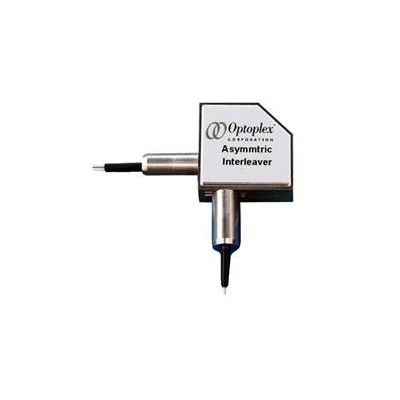
Optoplex - Asymmetric Optical Interleaver
Conventional Optical Interleaver is Symmetric Optical Interleaver. By "Symmetric" we mean that both "Odd" and "Even" channels have the same passband widths and waveforms. Optoplex offers a new type of Optical Interleaver whose "Odd" and "Even" channels have different passband widths and waveforms. This is FlexSlicer™ Asymmetric Optical Interleaver.
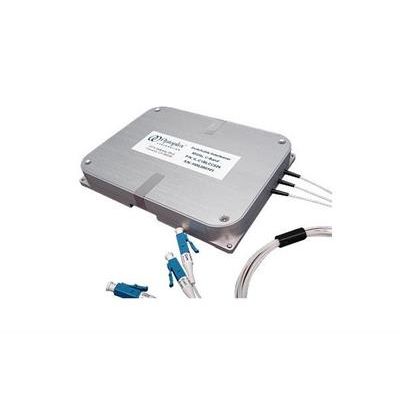
Optoplex - Switchable Optical Interleaver / De-Interleaver
In a switchable interleaver, there are two operation modes: Mode A: All pass, Mode B: Interleaver. In Mode A, the system operates at any channel spacing, in which all channels pass through the device and output from one of the two output ports as if there is no extra device inserted. When the system is switched to Mode B, the device operates as a normal optical interleaver, such 50-100GHz interleaver.