


- Home
- Companies
- Quest-Tec Solutions
- Products
Quest-Tec Solutions products
Magne-Trac Liquid Level Indicators
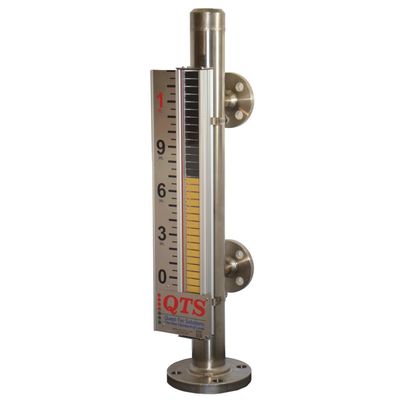
Magne-Trac - Model Standard - Magnetic Level Indicator
The Magne-Trac product line provides one of the safest and most economical ways to meet your level measurement requirements. In applications for extreme pressure, temperature, vibration, and highly corrosive or hazardous material, Magne-Trac gauge will perform where other fail. Features include lower installation costs, easy to read liquid level indication, and low maintenance. Constructed of non-magnetic materials including standard 316 SST. Exotic materials such as Alloy. 20 & Hastelloy C are available. Traditional inlet & outlet mounted design displaying liquid level to match the vessel level. Complete with flange end closure for accessibility to float. Magne-Trac chambers are available to ASME 31.1 and 31.3.
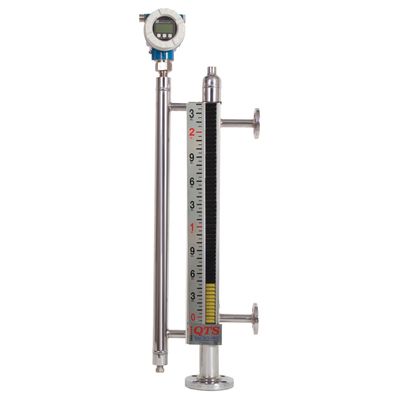
Magne-Trac - Model Plus - Magnetic Level Indicator + Bridle Chamber
The Magne-Trac Plus combines a Magne-Trac magnetic level indicator with a Bridle-Trac bypass chamber, in which a customer specified guided wave or non-contact radar may be installed. Although either instrument may be connected to the vessel, Questtec recommends that the bridle functions as the primary chamber. By using the magnetic gauge as the secondary chamber, the customer will have the option to rotate the indicator up to 180 degrees easily in the field. The two chambers may welded or flanged together; QTS recommends installing valves in between the magnetic gauge and bridle chamber so one may be isolated if necessary.
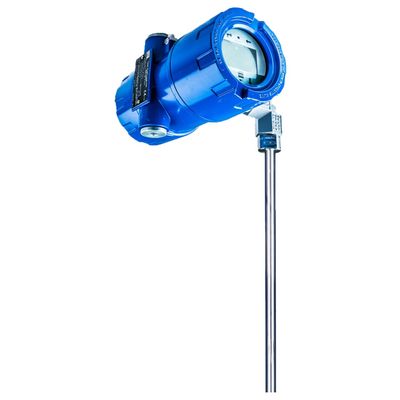
Magne-Trac - Model MTLT-5000 - Magnetostrictive Level Transmitter
The MTLT-5000 is based upon the magnetostrictive principle. The sensing tube contains a wire which is pulsed at fixed time intervals. The interaction of the current pulse with the magnetic field created by the magnetic float causes a torsion stress wave to be induced in the wire. This torsion propagates along the wire at a known velocity, from the position of the magnetic float and toward both ends of the wire. A patented piezo-magnetic sensing element placed in the transmitter assembly converts the received mechanical torsion into an electrical return pulse. The microprocessor-based electronics measures the elapsed time between the start and return pulses and converts it into a 4-20 mA DC output which is proportional to the level being measured.