


- Home
- Companies
- Trinity Consultants
- Software
Trinity Consultants software
Explosion Damage Assessment Models
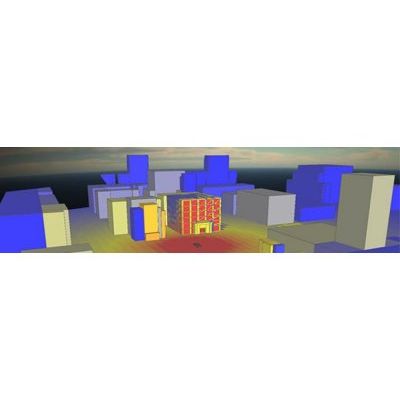
BREEZE ExDAM - Explosion Damage & Injury Assessment Model
BREEZE ExDAM® (Explosion Damage & Injury Assessment Model) is a unique, efficient 3D explosion consequence modeling suite that allows users to predict injury and damage resulting from the detonation of high explosive and vapor cloud explosions. BREEZE ExDAM contains the High Explosive Damage Assessment Model (HExDAM) and Vapor Cloud Explosion Damage Assessment Model (VExDAM). These numerical models provide a fast and accurate means to calculate structure damage and personnel injury due to overpressure (OP), dynamic pressure (DP), and impulse (IP) distributions. Take a look at the companion product, BREEZE VASDIP, which is designed to compute vulnerability parameters of structures and human body components resulting from explosion impacts for use in BREEZE ExDAM HExDAM and VExDAM modules.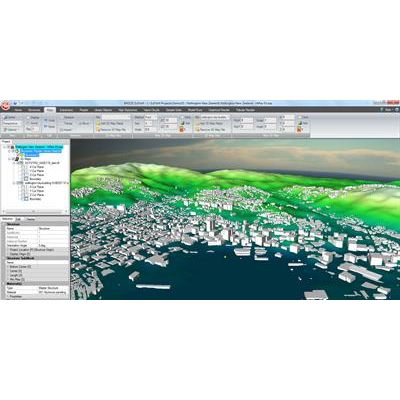
BREEZE ExDAM - 3D Extend Module
BREEZE ExDAM 8 HExDAM Module contains the High Explosive (HE) numerical model. It provides a fast and accurate means to predict over/dynamic pressure, impulse, and then damage/injury due to primary/secondary HEs with consideration of shielding effect. It is designed to replace the previous BREEZE HExDAM.
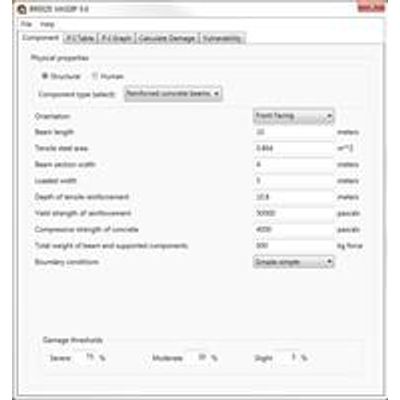
BREEZE - Model VASDIP - Explosion Impact Vulnerability Assessment Software
BREEZE VASDIP is an application used for assessing the vulnerability of structures and human body components resulting from explosion impacts. With this program, blast damage and injury are communicated using the most recently developed Pressure-Impulse (P-I) diagrams and users have the ability to compute changes in vulnerability as a function of individual structural and human properties. This functionality makes VASDIP invaluable when performing cost and risk analysis. VASDIP is designed to calculate vulnerability parameters for use in BREEZE ExDAM HExDAM and VExDAM, making it an excellent companion product to these modules for explosion modelers. BREEZE VASDIP can also be used independently to view damage data calculations for structures and human body components and to determine how such vulnerability changes as structural design and human parameters are varied.