

Geo Products, L.L.C. - EnviroGrid Cellular Confinement (Geocell)
- Home
- Companies & Suppliers
- Geo Products, L.L.C. - EnviroGrid ...
- Downloads
- Design and Installation Guidelines for ...
Design and Installation Guidelines for Soil Stabilization Manual
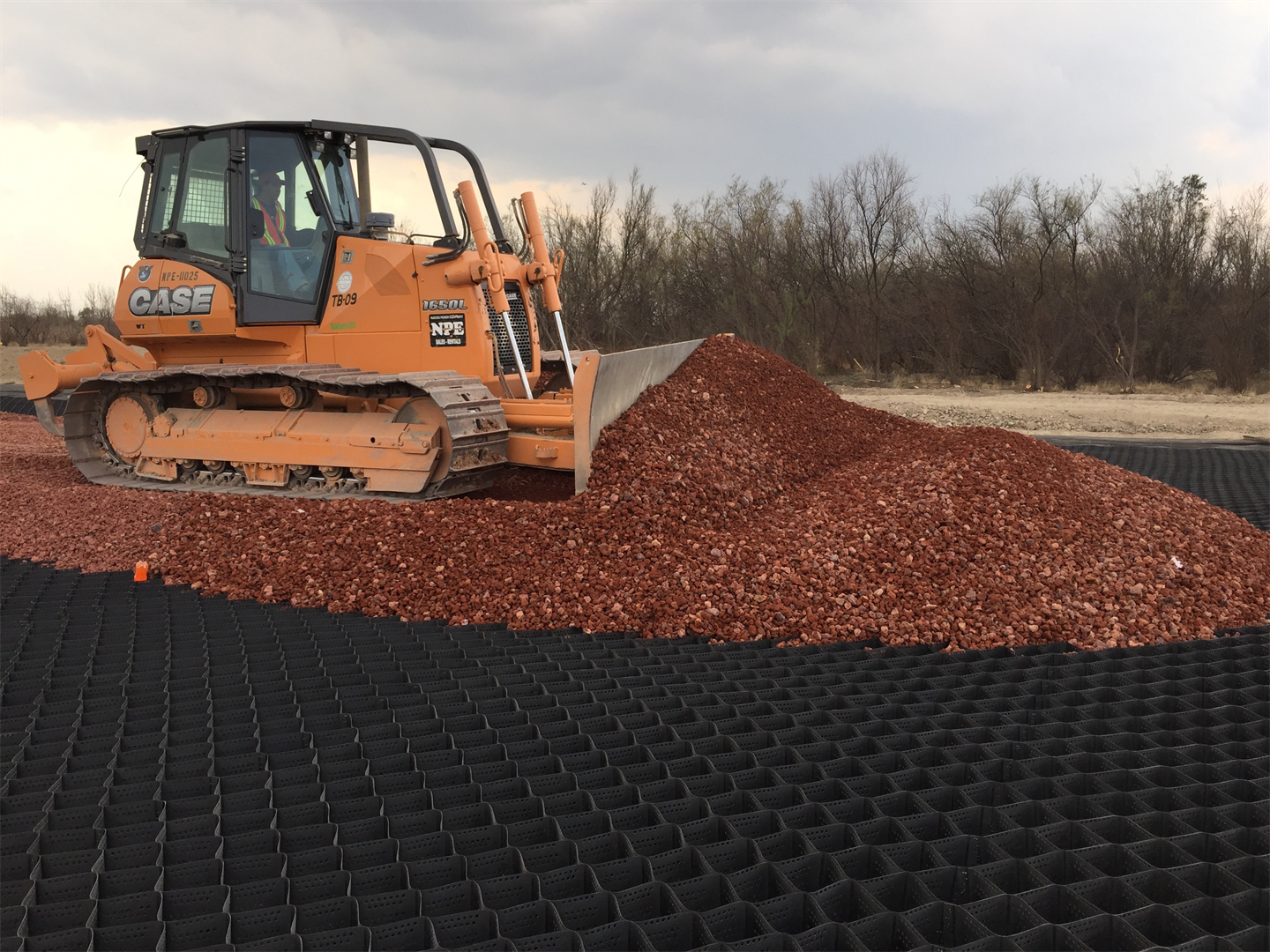
1 | P a g e Design and Installation Guidelines for Soil Stabilization Geo Products, LLC 8615 Golden Spike Lane Houston, TX 77086 Phone: 281.820.5493 Fax: 281.820.5499 www.geoproducts.org 2 | P a g e Design Guidelines for Soil Stabilization 3 The EnviroGrid Solution 4 Designing with Envirogrid 5 Installation 8 3 | P a g e Design Guidelines for Soil Stabilization When traffic loads are applied to a soil subgrade, the soil will not deform or rut if the shear strength of the soil exceeds the applied loads. The strength of the soil is a function of such characteristics as its angle of internal friction, its cohesion, and its degree of compaction. Most road and parking systems consists of one or more layers of good quality fill materials placed and compacted on soil subgrades. The fill materials allow the system to support traffic loads that the soil, by itself, would not be able to withstand. The function of the layer(s) of base material is to distribute the imposed loads over a large area, thereby reducing the pressure (load divided by area), which is transferred to the subgrade. The base material is able to distribute the loads because the individual aggregate particles lock together. Applied loads are transmitted through the base material both as vertical and horizontal forces. If the horizontal (lateral) forces push the base material sideways, rutting develops, resulting in a thinner layer less able to resist additional load applications which leads to failure. Even a good quality base material, with the proper internal strength and interlocking of individual particles, can be forced to move laterally. The poor quality subgrade in contact with the base material does not provide the required friction at the interface to restrain the movement. 4 | P a g e The EnviroGrid Solution In order to prevent lateral movement at the bottom or within the base layer, high modulus (low elongation) geotextiles or geogrids have been used for many years. Because of their strength, resistance to elongation, and structure, fabrics and grids are more capable of restraining the lateral movement of the base materials with which they come in contact. Although they are very useful in many stabilization applications, fabrics and grids can only have an effect at the boundary where they contact the base material/soil. Prevention of lateral movement of the base materials above and below this boundary still depends totally upon the quality of the base material itself. EnviroGrid takes the concept of confinement from two dimensions (length and width) and expands it to a third dimension (depth). This vertical and horizontal confinement of the entire depth of the base layer represents a quantum leap in stabilization technology, and has major implications upon cost effectiveness and the project’s long-term performance. Because the cell walls resist lateral movement, a lower quality, lower cost, base material can be used. Additionally, the base material can be more open graded which will dramatically improve drainage of the system, resulting in a longer expected life for the road/parking lot. If a parking lot is not paved, storm water would be allowed to seep into the subgrade, possibly eliminating the need for a detention pond. Another major benefit of stabilization soils with EnviroGrid is the effectiveness of a geocell to distribute applied loads over a large area. Since each cell within a section is connected to adjoining cells, each section of EnviroGrid acts as a large mat or pad. EnviroGrid significantly reduces the pressure applied to the subgrade by a load exerted on the top surface of the EnviroGrid . The benefit is that stabilization can be achieved with a minimum amount of base material used in conjunction with EnviroGrid . 5 | P a g e Designing with EnviroGrid EnviroGrid filled with a base material acts as a layer in a multi-layer road system. A broadly accepted method used to analyze and design multi-layered road systems is a two-step procedure developed by AASHTO (American Association of Highway and Transportation Officials). THE FIRST STEP The engineer determines the necessary overall strength of the road system, which is called the required Structural Number (SN). The SN is a function of three (3) factors: 1. Soil Support Value (SSV) The strength of the subgrade soil is determined by one of a variety of standard methods. Through the use of equivalence tables, the subgrade strength is used to select the appropriate Soil Support Value. 2. Equivalent Axle Load (EAL) The expected traffic loads over the life of the system are tabulated. These include H2 loading (20-ton trucks with a given wheel configuration), lighter trucks, autos, etc. Using a table developed by AASHTO, each type of loading is converted to a common, single measure based on the impact, which that loading is expected to impose upon the road system. The common measure is a single 18,000 lb. Axle load and is called the Equivalent Axle Load. 3. Regional Factor (RF) This factor accounts for the susceptibility of the subgrade soils at the construction site to conditions of moisture and temperature. The Regional Factor, which typically ranges from 0.5 to 3.0 in the forty-eight contiguous states, can be selected from a map developed for this purpose. The engineer enters these three factors into a monograph developed by AASHTO that determines the required SN. 6 | P a g e THE SECOND STEP Select base materials and the thickness of the layers of those materials which, when combined, will provide an SN equal to or greater than the required SN. Each base material is assigned a Structural Coefficient (SC), which is related to the ability of the material to spread applied loads. It has been conservatively determined that the SC for EnviroGrid filled with granular material such as sandy soil is 0.35. A better load-bearing fill material would increase the EnviroGrid structural coefficient. In the following table are structural coefficients for various fill material and EnviroGrid filled with sandy soil, and the resulting equivalent layer thickness: EQUIVALENT LAYER THICKNESS* ASPHALTIC CONCRETE CRUSHED STONE SANDY GRAVEL LIME STABILIZED SOIL SANDY SOIL 4” EnviroGrid (SC = 0.35) 3.4 inches 10 inches 12.7 inches 17.5 inches 20 inches 6” EnviroGrid (SC = 0.35) 5.1 inches 15 inches 19.1 inches 26.3 inches 30 inches 8” EnviroGrid (SC = 0.35) 6.8 inches 20 inches 25.5 inches 35 inches 40 inches * Filled with Sandy Soil Multiplying the SC of a given material by the thickness of the layer of that material, in inches, determines the contribution of that layer toward the required SN. For example, if the required SN is 2.90 and the engineer wants the top layer of the road system to be 2” of asphalt concrete, he or she could make either of the following selections for the remainder of the base: 1. 15” of crushed stone 2. 6” EnviroGrid with sandy soil (15 x .14) + (2 x .41) = 2.92 (6 x .35) + (2 x .41) = 2.92 7 | P a g e Alternatively, if the engineer knows how much of a base material is normally used in a given design, he or she can substitute EnviroGrid for that material in relation to their structural coefficients. For example, EnviroGrid filled with sandy soil has five time (.35/.07=5) the support value of sandy soil without EnviroGrid (In his book entitled Designing with Geosynthetics, Fourth Edition, Professor Robert Koerner provides an example which shows that the use of an 8” EnviroGrid increases the bearing capacity of sandy soil by 13 times). Thus, 4” EnviroGrid filled with sandy soil has the same load bearing strength as 20” of sandy soil without EnviroGrid . Therefore, if a road design calls for 18” of a sandy soil fill, the engineer could reduce that amount to 4” EnviroGrid with the same type fill and have a stronger base. The designer can add local fill materials to the above table with the appropriate AASHTO structural coefficients to calculate the savings using EnviroGrid . Examples of such locally available materials are crushed shell in coastal areas, river gravel in mountainous areas, and high quality limestone in other areas. A complete description of the AASHTO design procedure, as well as its development and complete software for use in design, is available from AASHTO at (202)624-5800 or at www.aashto.org. 8 | P a g e Installation A two to four man crew of semi-skilled labor without any specialized equipment installs EnviroGrid quickly and easily. Sections are shipped to the jobsite in collapsed form, measuring 12’ x 5” x cell height. 1. If required, excavate and shape the subgrade soil to the elevations, grades, and dimensions as shown on the drawings. 2. If the infill material is different from the sub-base material, a geotextile should be used as a separator. A woven or nonwoven fabric is selected depending on whether strength or permeability is important. Simply unroll the geotextile directly on the subgrade, overlapping adjacent panels by 18” (minimum). 3. Determine where the first section of EnviroGrid is to be placed and put stakes at the four corners. 4. Stretch a section beyond its intended length and then allow it to relax. Place the section over the embedded stakes. Additional stakes may be needed along the perimeter in order to get full expansion of each cell. In situations where it is not practical to use stakes (over rocky soil, etc.) an installation frame may be needed. Adjacent sections are installed in a similar fashion and butted or stapled together to achieve continuous coverage. 5. Fill the first rows of cells with a front-end loader or dump truck and push the fill into cells using shovels or a bulldozer blade. A “ramp” of fill material immediately adjacent to the EnviroGrid will likely be necessary to allow equipment to climb onto the EnviroGrid . Continue until all cells are filled. Never allow any equipment to drive over unfilled cells. Always overfill the cells slightly to allow for consolidation. 6. Next, it is necessary to compact the EnviroGrid system. The most common method of compacting is through multiple passes by the tracked equipment used to spread the infill. A vibrating roller and/or water may be required to achieve the specified lever of compaction. 7. Once the cells are filled and the system is compacted, the EnviroGrid base is ready to withstand heavy traffic loads. Geo Products, LLC provides this information only as an accommodation to our customers. No warranty or other representation regarding the suitability of the application procedures is made due to the fact that each installation has specific requirements that may not have been considered in this generalized procedure. Geo Products, LLC makes no warranties or representations regarding the suitability of its EnviroGrid® for specific uses or applications. Our liability is limited to furnishing, without charge, a replacement for any EnviroGrid® that is proven defective under normal use and service. THE FIRST STEP The engineer determines the necessary overall strength of the road system, which is called the required Structural Number (SN). The SN is a function of three (3) factors: 1. Soil Support Value (SSV) 2. Equivalent Axle Load (EAL) 3. Regional Factor (RF)
Most popular related searches