

- Home
- Companies
- Water Environment Federation (WEF)
- Events
- Forum 2022 - Particles and Colloids - ...
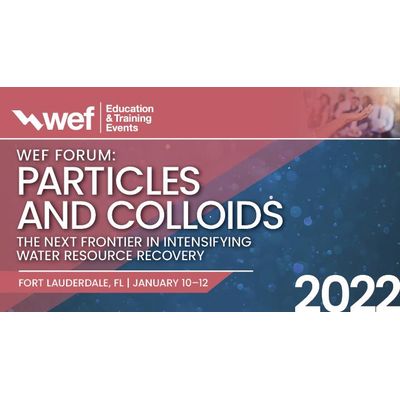
Forum 2022 - Particles and Colloids - the Next Frontier in Intensifying Water Resource
WEF is moving the Forum on Particles and Colloids, initially scheduled for July 2021, to January 2022. This event brings together a small group of water professionals worldwide to foster far-reaching and in-depth discussions on a specific topic of interest in an in-person format. The WEF Forum brings a small group of about 150 water professionals together to foster far-reaching and in-depth discussions on a specific topic of interest. It is a single track, two and a half-day experience that includes group meals and evening activities where discussions around the event topic continue, leading to impactful conclusions and developments.
Attendees of the Forum 2022 will take a deep dive into the world of particles and colloids (P&Cs) to understand how best to apply modern P&C science to engineered water systems, identifying new areas for exploration. This Forum will feature short and highly technical presentations providing context on the following session topics:
- Session 1: P&Cs Beyond the Standard Turbidity and TSS
- Session 2: Particle Type and Particle Properties
- Session 3: P&C Processes
- Session 4: Methods for Characterization and Monitoring P&Cs
Facilitated discussions around these topics will advance the overall knowledge of the P&C industry, leading to impactful new innovative ideas and developments.
The official Forum hashtag is #WEFForum. Be sure to use it in your social media posts, and RSVP to the Facebook event!
More information about the Forum 2022 program is coming soon.
In the water industry, particles and colloids (P&Cs) are everywhere: a resource to be recovered at preliminary/primary stage (front), a driver of reaction rates for the secondary treatment (middle), and a liability to be removed in the final effluent for high-end water reuse (end). The real science and engineering of P&Cs is often oversimplified and, in most cases, poorly understood. Kinetic modeling parameters to account for particle behavior like P&C surface chemistries, size, density and composition are mostly neglected, and current methods for characterizing P&C are rudimentary at best.
The WEF Forum seeks to advance our understanding of how best to apply modern P&C science to engineered water systems as well as identify new areas for exploration. This forum will consider the broad problems and opportunities of P&Cs ranging from physical and chemical to biological reactions associated with P&C. In addition, the program will be focused on the most interesting and exciting P&C science and research innovation opportunities for treatment process design, operation and intensification.
- Peter Vanrolleghem, Université Laval, Co-Chair
- Kendra Sveum, Loudoun Water, Co-Chair
- Erika Bailey, City of Raleigh Public Utilities
- Charles Bott, Hampton Roads Sanitation District
- Jeanette Brown, Manhattan College
- Chris deBarbadillo, DC Water
- Jose Jimenez, Brown and Caldwell
- Wendell Khunjar, Hazen
- Tom Kunetz, MWRDGC
- Jim McQuarrie, Denver MWRD
- Adrien Moreau, Suez
- Sudhir Murthy, NEWhub
- Pusker Regmi, Brown and Caldwell
- Peter Schauer, Clean Water Services
- Art Umble, Stantec