

- Home
- Companies
- Harmony Enterprises, Inc.
- News
- Metal Fabrication Workforce Development
Metal Fabrication Workforce Development
In rural communities, the future of manufacturing does not begin in a factory.
It begins in a classroom. At Harmony Enterprises, we believe one of the most powerful ways to strengthen the manufacturing workforce is to meet students where learning happens and bring real experience directly into the process. That belief is guiding our hands on partnership with Kelsey Biel, the welding instructor at Fillmore Central High School and her students in the metal fabrication class. Its leading to real life, hands-on metal fabrication workforce development in our own community.
Throughout the metal fabrication course, Harmony team members work side by side with students during key moments of instruction, helping connect theory to practice and curiosity to career pathways.
The Fillmore Central metal fabrication class meets first hour, from 8:20 to 9:36 AM, setting the tone for the day with focused, hands on learning. From the very first weeks, students are introduced to the fundamentals that mirror what happens in real manufacturing environments.
Early lessons center on welding safety, equipment setup, understanding electrical current, and learning how to move from a plan to a finished weld. As students progress, they dive deeper into SMAW, MIG, and later TIG and plasma table concepts, building confidence through repetition, problem solving, and critique.
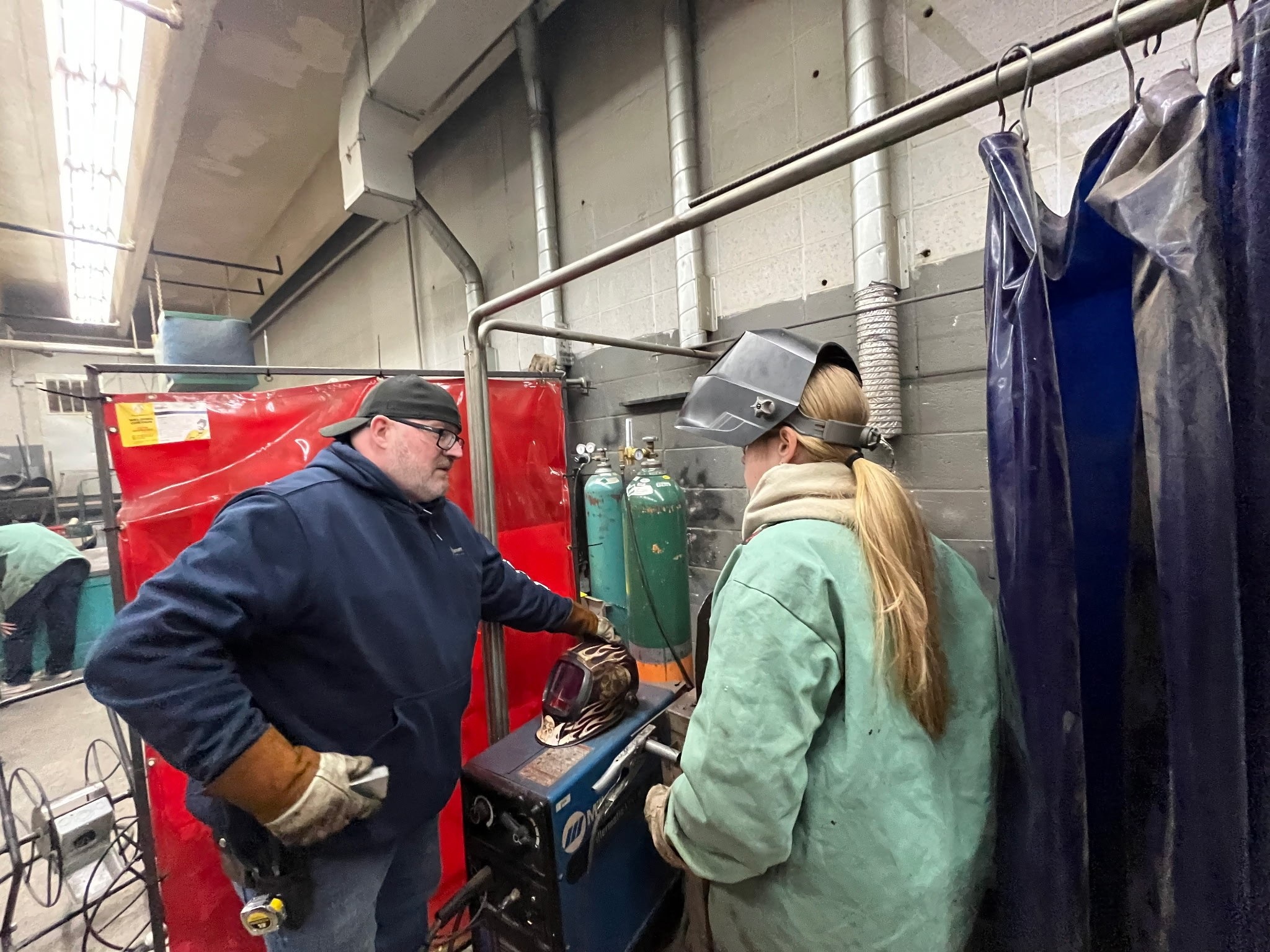
Harmony’s involvement is intentionally aligned with these milestones. Our talented welders and fabricators are coming into the classroom once per week this semester to share their expertise with these eager students.
When students are learning welding mechanics, our team talks about angle, speed, and consistency from years of experience on the shop floor. When they are introduced to welding plans and symbols, we show how those same drawings drive production efficiency, quality, and communication inside a manufacturing facility.
One of the most impactful moments in the course is when students begin creating and following welding plans. This is where Harmony team members step in to share how fabrication plans are developed in the real world.
Students learn how a plan changes when:
- A customer has unique requirements
- A large production order must stay on schedule
- Material availability affects design decisions
- Quality standards cannot be compromised
These conversations turn abstract assignments into realistic decision making exercises and help students understand that welding is not just a skill, it is part of a larger system.
As the course moves into grinders, repair techniques, plasma cutting, and machine setup, Harmony staff provide hands on insight that cannot be found in a textbook.
Students see:
- How to diagnose and repair weld failures
- Why certain tools are chosen for specific tasks
- How digital plans move from a computer to a machine
- What preparation is required before cutting or welding ever begins
When students start building project plans that combine SMAW, MIG, symbols, and material selection, Harmony’s role becomes one of mentor and guide. We help them think through sequencing, time management, and realistic execution.
As students advance into independent projects, bending metal, machine welding, and final fabrication, the classroom begins to look and feel like a working shop. Plans are refined. Methods are documented. Pricing and material decisions are considered.
Harmony team members support students as they:
- Present project plans
- Receive and apply critiques
- Document progress with photos and captions
- Troubleshoot issues when things do not go as planned
These are the same skills required in manufacturing careers, and students experience them firsthand before graduation.
As the course wraps up later in the spring the students take part in a local welding competition, with the top performers moving on to compete in the regional FutureForward™ Welding Competition on April 15th, 2026 at Local 6 Plumbers & Pipefitters Training Center in Rochester.
We help students understand how to approach a timed event, how to prioritize steps, and how to balance speed with quality. Just as importantly, we talk about what comes next.
Students learn about career pathways in metal fabrication, from welding and fabrication to machining, quality, engineering, and leadership roles. They see that manufacturing offers growth, stability, and purpose, especially in rural communities like ours.
This partnership is not about recruitment brochures or job postings. It is about presence. Lane Powell, New Business Development Manager & Vice-Chair of the SE MN Workforce Development Board of Directors states, “By showing up consistently, sharing real experience, and respecting the learning process, Harmony Enterprises is investing in people long before they ever consider filling out an application. That’s what connecting with the emerging workforce is all about.”
“By showing up consistently, sharing real experience, and respecting the learning process, Harmony Enterprises is investing in people long before they ever consider filling out an application. That’s what connecting with the emerging workforce is all about.”
-Lane Powell, Harmony Enterprises
We are proud to support the instructors and master craftsman who make this work possible. We are inspired by the students who bring curiosity and determination into the shop every morning. And we are committed to strengthening the future of manufacturing by building it together with our community.
Because the strongest workforce is not found.
It is grown.