

- Home
- Companies
- Henan Doing Machinery Equipment Co., ...
- News
- Tire Pyrolysis Carbon Black: ...


Tire Pyrolysis Carbon Black: Transforming Waste Tires into High-Value Resources
Globally, around 4 billion waste tires are either buried or stockpiled, with an additional 1.8 billion new tires discarded each year. Through pyrolysis processing, these discarded tires can be converted into valuable by-products—one of the most important being pyrolysis carbon black (PCB). On average, every 10 kilograms of automotive tires contain roughly 3 kilograms of carbon black, leading to a huge annual output of this material. Keep reading to discover how waste tires are turned into valuable PCB.
Environmental Risks Posed by Accumulated Waste Tires
1. Land Occupation and Visual Blight
Discarded tires take up large amounts of landfill space due to their bulky size and non-biodegradable nature. Unlike organic substances, tires do not decompose easily and can persist in the environment for centuries. These tire piles not only reduce the amount of usable land but also create unsightly landscapes that detract from the aesthetics of both urban and rural areas. Large-scale tire dumps have often become symbols of poor industrial waste management and disregard for environmental protection.
2. Fire Hazards and Air Pollution Threats
Stockpiled tires are highly flammable. Once ignited, they are extremely difficult to put out because of their rubber composition and internal void structure, which sustains smoldering combustion. Tire fires emit thick black smoke, carbon monoxide, sulfur compounds, and polycyclic aromatic hydrocarbons (PAHs)—pollutants that can contaminate the air and soil for years.
3. Breeding Grounds for Disease-Carrying Vectors
The hollow interiors of discarded tires easily collect rainwater, forming stagnant pools that serve as ideal breeding grounds for mosquitoes. This increases the risk of vector-borne diseases such as dengue fever, malaria, and Zika virus in nearby communities. Improperly stored tires thus inadvertently become threats to public health.
4. Long-Term Ecological Damage
Over time, weathering and ultraviolet radiation cause the surface of tires to degrade, releasing micro-rubber particles into the environment. These particles can leach heavy metals and toxic additives into soil and waterways, posing long-term risks to aquatic ecosystems and biodiversity. The cumulative ecological burden underscores the urgency of adopting sustainable tire recycling and pyrolysis recovery technologies.
The Formation Process of Pyrolysis Carbon Black
Currently, pyrolysis is an efficient and eco-friendly method for managing waste tires. The following section explains how tire pyrolysis carbon black is produced.
1. Polymer Decomposition and Volatilization
Tires consist of cross-linked rubber polymers and various additives (including carbon black, sulfur, and metals). During pyrolysis—heating in an oxygen-depleted environment—the rubber matrix starts to break down. When temperatures exceed approximately 400 °C, long polymer chains undergo depolymerization (breaking into smaller fragments), dehydrogenation (losing hydrogen molecules), and pyrolysis into volatile hydrocarbons. These volatile compounds either escape as gases or condense into oils, leaving behind a carbon-rich char. Studies indicate that during high-temperature pyrolysis of waste tires, the yield of carbon black rises significantly as temperatures increase (for example, from around 1100 °C to 1300 °C) and when the residence time is adequate.
2. Solid Carbon Formation and Refinement
After the volatile substances are removed, the remaining carbonaceous residue begins to restructure: small aromatic rings polymerize and condense into graphitic or quasi-graphitic structures, particles nucleate and grow, and a carbon black-like morphology takes shape. The degree of graphitization, particle size, and specific surface area are largely determined by pyrolysis temperature and residence time—higher temperatures and sufficient dwell time favor smaller particles and more ordered carbon structures. Following pyrolysis, the char may be cooled in an inert atmosphere, separated from metal wires or mineral additives, and further processed (through milling, activation, or surface treatment) to enhance its structure and remove residual volatiles or contaminants.
Key Characteristics of Pyrolysis Carbon Black
1. Microstructure and Morphology
Carbon black is composed of fine, amorphous carbon particles typically ranging from 10 to 100 nanometers in size. These particles form complex aggregates and agglomerates, creating a high-surface-area network that impacts color intensity, electrical conductivity, and reinforcement capabilities. The degree of aggregation directly influences the performance of carbon black in industrial materials.
2. Surface Chemistry
The surface of carbon black contains various functional groups, such as hydroxyl, carboxyl, and quinone structures. These chemical sites determine its adsorption properties and compatibility with organic and polymeric matrices. Controlled surface modification can improve dispersion and bonding strength in composite materials.
3. Thermal and Electrical Properties
Carbon black boasts high thermal stability and excellent electrical conductivity. It resists decomposition at elevated temperatures and acts as an efficient conductor of heat and electricity. Its black color and opacity stem from strong light absorption, a result of the extended π-bond network within its carbon layers.
Major Applications of Pyrolysis Carbon Black
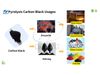
Global carbon black production reaches approximately 14 million tons annually, and refined pyrolysis carbon black is emerging as a sustainable alternative across multiple industries. Below are its main application sectors and their respective market shares.
1. Tire Manufacturing (70%)
Refined pyrolysis carbon black is primarily used in tire production, especially for medium-to-low-performance tires.
2. Technical Rubber Products (20%)
Around 20% of pyrolysis carbon black is used in industrial and automotive rubber products where material strength and resilience are important but not required to meet tire-grade standards. Common applications include:
Conveyor belts, rubber hoses, gaskets, and molded components.
Applications requiring moderate reinforcement and dimensional stability.
3. Plastics, Dyes, and Pigments (10%)
Approximately 10% of refined pyrolysis carbon black is utilized in plastics manufacturing and pigment formulations. While its dispersion and gloss may not match high-end pigments, it delivers satisfactory performance for cost-sensitive applications:
Used in black masterbatches, plastic films, and containers.
Applied in inks, industrial paints, and low-grade coatings.
Pyrolysis carbon black is more than just a by-product—it is a practical, resource-saving material with growing significance across various sectors. As pyrolysis technology advances, the demand for this sustainable carbon source is expected to expand further. Partner with DOING Group to enhance the overall utilization efficiency of end-of-life tire resources.