


- Home
- Companies
- Zurich Instruments AG
- Products
- Zurich Instruments - Model MFIA - 500 ...
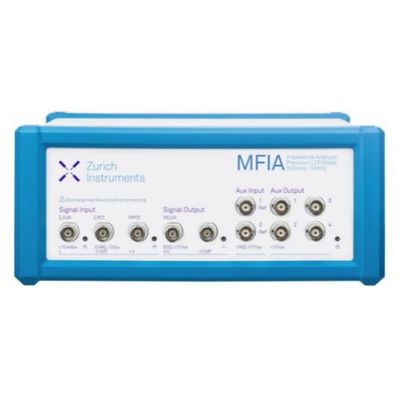
Zurich Instruments - Model MFIA -500 kHz / 5 MHz Impedance Analyzer
The Zurich Instruments MFIA is a digital impedance analyzer and precision LCR meter that sets the new standard for impedance measurements in the frequency range from 1 mHz to 500 kHz (extended to 5 MHz when upgraded). The MFIA has a basic accuracy of 0.05% and operates over a measurement range spanning from 1 mΩ to 1 TΩ. It is also characterized by a high measurement repeatability and small temperature drift. Every MFIA comes with the LabOne user interface and with the MFITF Impedance Test Fixture.
- 1 mHz to 500 kHz, 1 mΩ to 1 TΩ
- Optional upgrade to 5 MHz
- 0.05% basic accuracy
- Compensation Advisor and Confidence Indicator
- Full MFLI Lock-in Amplifier functionality
- LabOne® Sweeper tool for frequency, bias voltage, and test signal amplitude response measurements
- LabOne APIs for Python, C, MATLAB®, LabVIEW™ and .NET
- Electrical engineering: sensors, supercapacitors, semiconductor characterization, DLTS, display technology, ultra-high resistors, high-Q dielectrics
- Materials research: polymer dielectrics, ceramics and composites, solar materials, thin-film and nanostructure characterization
- Bioimpedance: tissue impedance analysis, cell growth, food research
With multi-device synchronization (MDS) you can operate multiple MFIAs as a single multi-channel device:
- Operate all instruments from a single LabOne user interface and LabOne API.
- Lock in phase all instrument clocks and oscillators (stable phase relationship).
- Synchronize time stamps and sampling rates for automatic alignment of measurement data.
The front panel of the MFIA features 1 current signal input, 1 differential voltage input, 1 differential signal output, 2 auxiliary inputs that can work as reference inputs, and 4 auxiliary outputs. Both signal inputs and outputs can be operated in single-ended and differential mode for experiments that require extra noise immunity. The signal ground can be referenced to the instrument ground or to the BNC shield of the signal inputs.
The back panel offers additional BNC connectors comprising 2 trigger inputs, 2 trigger outputs, and 1 input and 1 output for 10 MHz clock synchronization. Moreover, a SCSI connector offers access to all DIO channels. The units can be operated with standard 90 - 240 V mains supply or by an external 12 V DC power supply (e.g., an external battery pack) to break up ground loops.
Temperature changes of the instrument can severely limit start-up speed and measurement repeatability. The MFIA performs exceptionally well in both aspects, as shown by the start-up drift graph above and by the reactance chart at the bottom of the page. You can start the first measurements after 25 s from turning on the instrument.
Voltage and current measurementsVoltage measurements and current measurements are both supported by the MFIA. The analog front end features variable input impedance as well as AC/DC coupling selection, and the high-frequency analog to digital sampling provides a large oversampling factor. This ensures superior lock-in performance and high signal fidelity for the Scope.
- General
- Dimensions : 28.3 x 23.2 x 10.2 cm; 11.1 x 9.2 x 4 inch
- Weight : 3.8 kg; 8.4 lbs
- Power supply : AC: 100 to 240 V; DC: 12 V, 2 A
- Interface : USB 2.0, LAN 1GbE
- Basic specifications
- Frequency range : 1 mHz to 5 MHz
- Frequency resolution : 1 µHz
- Basic accuracy : 0.05%
- Basic temp. stability : 200 ppm/K
- Test signal level : 0 V to 2.1 Vrms; incl. monitoring
- Demodulator bandwidth : 276 µHz to 206 kHz
- DC bias signal level : 2T: ±10 V, 4T: ±3 V
- Compensation : SO, SOL, LLL, SL, L, OL
- Measurement parameters, range and typ. accuracy
- Impedance Z : 1 mΩ to 1 TΩ, 0.05%
- Admittance Y : 1 pS to 1 kS, 0.05%
- Voltage V : 0 V to 3 V, 1%
- Current I : 0 mA to 10 mA, 2%
- Phases ΘZ, ΘY, ΘV, ΘI : ±180 deg, 10 µdeg res.
- Resistance RS, RP1 : 1 mΩ to 1 TΩ, max(10 µOhm, 0.05%)
- Capacitance CS, CP1 : 10 fF to 1 F, max(10 fF, 0.05%)
- Inductance LS, LP1 : 100 nH to 1 H, max(10 nH, 0.05%)
- DC Resistance RDC : 1 mΩ to 10 GΩ, 2%
- Reactance X : 1 mΩ to 1 TΩ, 0.05%
- Conductance G, Susceptance B : 1 nS to 1 kS, max(100 nS, 0.05%)
- Loss coefficient D : 10-4 to 10`000
- Q factor : 10-4 to 10`000
- LabOne Sweeper
- Sweep parameters : Frequency, test signal amplitude, bias voltage, etc.
- Sweep points : 2 to 100`000
- Sweep resolution : Arbitrary, defined by start value, stop value, number of sweep points
- Display parameters : ZX, ZY, Z, ZΘ, VX, VY, VR, VΘ, IX, IY, IR, IΘ, model parameter 1/2, frequency, auxiliary input
- Display options : Single plot, dual plot (e.g., Bode plot), multi-trace
- Application modes : Impedance, frequency response analyzer, 3-omega, etc.
- Sweep modes : Sequential, binary, bidirectional, reverse
- Sweep step modes : Linear, logarithmic
- Sweep speed : 20 ms/pt for f > 10 kHz
- Additional tools and features
- LabOne toolset : Numerical, FFT Spectrum Analyzer, Plotter, SW Trigger, Scope
- APIs : C, .NET, MATLAB, LabVIEW, Python
- Modes : 2-terminal, 4-terminal
- Confidence Indicator : Suppression, compensation, overflow, underflow
- Input range control : Auto, impedance, manual
- Test signal amplitude : Auto, manual
- Bandwidth control : Auto, manual
- Replacement circuit models : Rp||Cp, Rs+Cs, Rs+Ls, G-B, D-Cs, Q-Cs, D-Ls, Q-Ls
- DCR measurements : Yes
- Test fixture compatibility : Yes