


- Home
- Companies
- Zurich Instruments AG
- Products
- Zurich Instruments - Model UHFLI - 600 ...
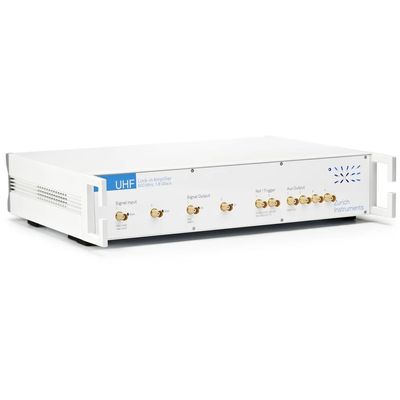
Zurich Instruments - Model UHFLI -600 MHz Lock-in Amplifier
The Zurich Instruments UHFLI is a digital lock-in amplifier that covers the frequency range from DC to 600 MHz. In addition to providing the highest operation frequency among all commercial lock-in amplifiers, the UHFLI offers the lowest time constant of 30 ns for demodulation – resulting in a demodulation bandwidth that exceeds 5 MHz. In combination with the widest choice of available options and the instrument control software LabOne, the UHFLI is the flagship of all Zurich Instruments products and represents the state of the art of today`s scientific instrumentation.
- 600 MHz operation frequency
- 2 independent lock-in units
- 2 high-performance signal generators
- 4 independent harmonics per lock-in unit
- High-resolution 12-bit scope with 65k samples
- Frequency Response Analyzer (FRA)
- FFT Spectrum Analyzer
- LabOne® toolset
- Laser spectroscopy: pump-probe, THz time-domain, ultrafast
- Scanning microscopy: high-speed AFM, SNOM, CARS-SRS
- Industrial production: failure analysis, laser voltage probing and imaging
- Quantum technologies: quantum computing, quantum communication, RF-reflectometry
- Sensing and actuation (MEMS)
- NMR
With multi-device synchronization (MDS) it is possible to operate multiple UHFLIs as a single multi-channel device:
- Operate all instruments from a single LabOne user interface and LabOne API.
- Lock in phase all instrument clocks and oscillators (stable phase relationship).
- Synchronize time stamps and sampling rates for automatic alignment of measurement data.
Lock-in operating modes
Internal reference mode: Single and dual lock-in
External reference mode: Single and dual lock-in
Auto reference mode: Single and dual lock-in
Triple-harmonic mode: 1 fundamental + 3 harmonics (simultaneous)
Multi-harmonic mode: 1 fundamental + 7 harmonics (simultaneous), requires UHF-MF option
Arbitrary frequency mode: 8 frequencies, requires UHF-MF option
UHF signal inputs
Frequency range: DC - 600 MHz
Input impedance: 50 Ω or 1 MΩ || 18 pF
Input voltage noise: 4 nV/√Hz above 100 kHz
Dynamic reserve: 100 dB
Input range (AC+DC): ±3.5 V
Input full range sensitivity: 1 nV to 1.5 V
A/D conversion: 12 bits, 1.8 GSa/s
UHF signal outputs
Frequency range: DC - 600 MHz
Output ranges: ±150 mV, ±1.5 V (high-impedance load)
-12.5 dBm, 7.5 dBm (50 Ω load)
D/A conversion: 14 bits, 1.8 GSa/s
Reference and nanosecond triggers
Frequency range: 10 Hz to 600 MHz (external reference)
Connectors: 2 bidirectional, 2 output, 2 input
Reference frequency resolution: 6 µHz
Reference phase angle resolution: 1.0 µ°
Demodulators
Frequency range: 1 mHz to 600 MHz
Number of demodulators: 8 dual-phase
Output sample rate on LAN: 2 MSa/s (total all demodulators), 64-bit full range
Output sample rate on USB: 100 kSa/s (total all demodulators), 64-bit full range
Output sample rate on Aux outputs: 28 MSa/s (for each auxiliary output), 16-bit
Filter time constant: 30 ns - 76 s
Filter bandwidth: 628 µHz to 5 MHz
Filter slope: 6, 12, 18, 24, 30, 36, 42, 48 dB/Oct
Scope
Input channels: Signal inputs, trigger inputs, auxiliary inputs, demodulator oscillator phase, demodulator X/Y/R/Theta, PID, boxcar, AU; certain signals only if options installed
Scope modes: Time domain, frequency domain (FFT)
Number of display channels: 1; 2 requires UHF-DIG option
Trigger channels: Signal inputs, signal outputs, oscillator phases, DIOs
Trigger modes: Edge
Sampling rates: 28 kSa/s to 1.8 GSa/s
Vertical resolution: 12 bits
Maximum number of samples per shot: 64 kSa; 128 MSa, requires UHF-DIG option
Bandwidth limit mode, vertical resolution increase: Sample decimation, averaging
Cursor math: Location, area, wave, peak, tracking, histogram
Spectrum Analyzer
Center frequency range: 0 - 600 MHz
Spectrum modes: FFT(X+iY), FFT(R), FFT(Θ), FFT(f) and FFT((dΘ/dt)/2π)
Statistical options: Amplitude, spectral density, power
Averaging modes: None, exponential moving average
Maximum number of samples per spectrum: 8.4 MSa
Maximum span: 800 kHz
Window functions: Rectangular, Hann, Hamming, Blackman Harris
Cursor math: Location, area, wave, peak, tracking, histogram
Sweeper
Scan parameters: Oscillator frequency, demodulator phase shift, auxiliary offset, signal output amplitudes, signal output offset, PID setpoint, boxcar delay and time; certain parameters only if options installed
Parameter sweep ranges: Full range, linear and logarithmic
Parameter sweep resolution: Arbitrary, defined by start/stop value and number of sweep points
Display parameters: Demodulator output (X, Y, R, Θ, f), auxiliary input
Display options: Single plot, dual plot (e.g., Bode plot), multi-trace
Statistical options: Amplitude, spectral density, power
Preset measurement modes: Parameter sweep, noise amplitude measurement, frequency response analyzer, 3-omega-sweep
Auxiliary signals
High-speed outputs: 4 channels, ±10 V, R, Θ, X, Y, or user defined
D/A converter: 16 bits, 28 MSa/s
D/A analog bandwidth: 7 MHz
High-speed inputs: 2 channels, ±10 V
A/D converter: 16 bits, 400 kSa/s
A/D analog bandwidth: 100 kHz
Connectivity and others
Host connection: LAN / Ethernet, 1 Gbit/s
USB 2.0 high-speed, 480 Mbit/s
Pre-amplifier control bus: 2 ZCtrl (RJ45 connectors) proprietary peripheral interface
Digital I/O: 32 bits, 50 MHz, general purpose
Clock: 10 MHz, input and output, ultra-high stable ovenized oscillator (OCXO)
0.5 ppm deviation (0.00005 ppm with UHF-RUB option)
General
Dimensions: 45 x 35 x 10 cm
17.7 x 13.6 x 3.9 inch, suited for 19 inch rack
Weight: 6.4 kg
Power supply AC line: 100-240 V (±10%), 50/60 Hz
Operating temperature: +5 °C to +40 °C
Operating environment: IEC61010, indoor location, installation category II, pollution degree 2
Operating altitude: Up to 2000 m
Signal connectors: BNC on front panel, SMA on back panel
PC operating systems: Windows 7, Windows 8, Windows 10, Linux