


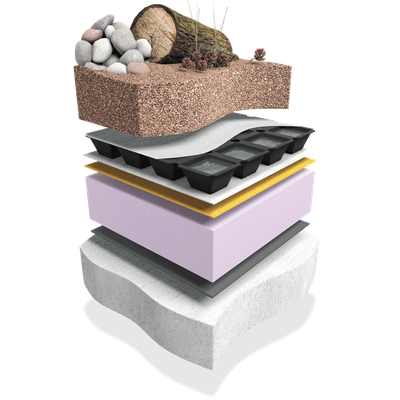
ABG - Biodiverse Roof Systems
Biodiverse roof systems characteristically consist of undulating growing media; typically 80mm – 150mm deep. This is planted with a variety of drought tolerant hardy plants or seed such as wildflowers, sedums, grasses and perennials.
Increased development of urban areas has seen a substantial increase in the construction of Biodiverse Roofs. Sometimes referred to as ‘Brown Roofs’, the purpose of a Biodiverse Roof is to replace and often enhance the habitat that would otherwise be lost to the new development. Designed to be self-sufficient and low-maintenance, Biodiverse Roofs are not typically constructed with the intention of being trafficked by pedestrians, but designed to create a natural habitat to support a variety of plants, birds, animals and invertebrates.
Biodiverse Roofs contribute significantly towards achieving BREEAM points. They also act to improve surrounding air quality, reduce the visual impact of the building and assist in the run-off and management of rainwater, as well as enhancing the acoustic and thermal properties of the roof.
Biodiverse Roof Systems have increased load implications compared to Extensive Green Roof Systems, with typical loads ranging from 100 – 200kg per m2. A Biodiverse Roof System typically consists of: Roofdrain 20mm geocomposite drainage board and reservoir layer; a biodiverse growing media; a vegetation layer (such as seed and plug plants), habitat enhancement features (hibernaculums) and aluminium edge profiles.
Typical Client Profile
- Landscape Architects
- Drainage Consultants
- Local Authority Planning Depts
- Roofing Contractors
- Roofing System Suppliers
- Main Client
- New build & refurb
- Commercial (Urban)
- Flat Roofs
- Roofs with limited access
- New build & refurb
- Commercial (Urban)
- Flat Roofs
- Roofs with limited access