


- Home
- Companies
- Attolight AG
- Products
- Attolight Mönch - Add-on System for TEM
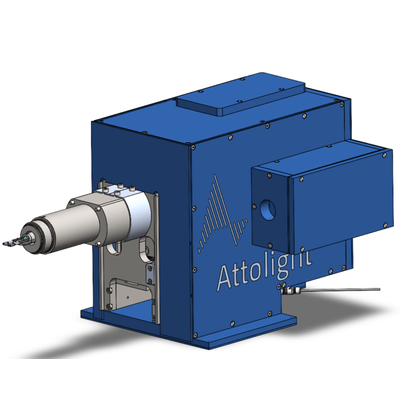
Attolight Mönch - Add-on System for TEM
The Mönch add-on is a specialized tool designed for transmission electron microscopes (TEM) that offers dual functionality in both light collection and light injection modes. Equipped with a unique mirror design, the Mönch allows for external coupling via either free space or optical fiber. In light collection mode, the system boasts an exceptional signal-to-noise ratio, leveraging features like a motorized arm with a 30mm X travel, a highly reflective mirror, and an optimized module. In light injection mode, it enables superior performance levels, facilitating electron imaging and light emission post-light or thermal excitation. This add-on is particularly effective for applications in semiconductors, time-resolved cathodoluminescence (CL), monolayers, and plasmonics. The proprietary reflective mirror is held by a retractable arm, ensuring independency from the sample holder while maintaining a low mirror-sample distance. With its patented asymmetric fiber, the Mönch stands out in both academia and industry for cutting-edge research.
The Mönch add-on is a unique tool that can operate in either a light collection or light injection mode, thanks to its specific mirror design. In addition, the flexibility of the add-on allows an external coupling either in free space or via an optical fiber.
In light collection mode, the Mönch add-on has been designed to achieve an unprecedented signal-to-noise ratio thanks to:
- A proprietary collection mirror with a curvature radius that fits in a small pole piece gap (down to 5mm) and a precise sub-micrometer alignment for a perfect adjustment of the mirror with respect to the sample.
- A working distance reduced to 300µm to optimize light collection efficiency
- A patented asymmetric optical fiber designed to preserve brightness and spectral resolution.
In light injection mode, an unprecedented level of performance is reached thanks to:
- A beam size reduced to few microns for localized excitation of your samples. Light injection can be operated to locally heat specific areas of the sample surface.
- The ability to perform injection and light collection measurements simultaneously.
Mirror independent from sample holder
- Flexibility, ease of alignment vs. e-beam and sample
- Free sample displacement (enables to scan a large sample surface)
- High curvature parabolic mirror (NA>0,4)
Motorized arm (X travel 30mm)
- Fine alignment (precision better than 100nm)
- Full retractation arm to enable EDX, EELS, 4D-STEM… analyses
Low mirror-sample distance
- Maximize light collection/injection
- Spot size down to 2µm-diameter
High mirror reflection
- Up to 90% from 200nm to nIR.
- Various mirror coatings available (ex: Gold coating for l>1.7µm)
Optimized module
- User-proof actuation system with absolute encoders (position recovered after power cut-off without need for calibration)
- Stage touch alarm
- Compatible with 120°C system vacuum bakeout
- Compatible optical fiber or free space (switch takes few seconds)
Collection mode
- Free space or through a fiber
Patented asymmetric fiber
- Fibers arrangement parallel to the entrance slit of the imaging spectrograph
- Brightness and spectral resolution are preserved
- Study of advanced materials, such as:
- Nitrides (GaN, InGaN, AlGaN, …);
- III-V (GaP, InP, GaAs, …);
- II-VI (CdTe, ZnO, …)
- Wide band-gap materials (diamond, AlN, BN)
- Compositional inhomogeneities in compound materials (e.g. Indium clustering in InGaN)
- Confined structures or heterostructures morphology to their optical properties
- Defects (vacancies, threading dislocations, stacking defaults, …)
- Plasmonics …