


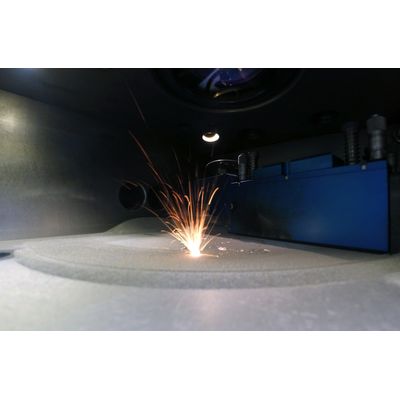
Additive Manufacturing
Additive manufacturing (AM), also known as 3D printing, is a process that creates three-dimensional objects by precisely layering materials based on a digital computer-aided design (CAD) model. A 3D printer uses the digital instructions to layer material, eventually generating a new 3D object. Several different modalities for 3D printing are available, with one of the most notable being powder bed fusion for metal AM. In this approach, high-power laser beams are tightly focused and scanned at high rates to melt small (30-50 um diameter) particles to create fully dense metal alloy parts that can range from a few millimeters to 1 meter in size.
This process goes by various names, including selective laser sintering (SLS), metal 3D printing, and laser metal powder bed fusion (PBF). Laser metal additive manufacturing offers an ideal method for creating highly complex parts with geometries that are too difficult for precision machining to produce and consolidate multiple parts or assemblies into a single piece to reduce weight and reimagine supply chains. The process also creates virtually no waste, making it popular when sustainable production is required.
First, an engineer designs a part using CAD software before being converted into a stereolithography (.STL) file showing how to slice the desired three-dimensional object into thin layers. During the build process, uniform layers of powder are spread across the build plate where the laser applies heat to melt them as it raster scans across the plate based on the part’s design. A wide variety of factors ranging from programmed scan paths, laser parameters, and distribution in powder sizing can all impact the resulting part quality. Optical in-situ real-time monitoring of the build process takes place in parallel to ensure the part meets the design criteria for the physical dimensions by observing key process metrics.
Gray Optics has deep expertise and design engineering experience with high-power laser metal additive manufacturing. Specifically, our product engineering expertise includes:
- Optics expertise. We design the optical and mechanical components of the entire optical pathway, from the laser to the powder bed. We also can design and build integrated meltpool monitoring detection modules for in-situ, real-time quality control of the build process. In addition to designing beam delivery paths, our experience also covers designing and specifying all optics and optical coatings for use with kilo-Watt class lasers.
- Benefits for customers. We help our customers optimize beam quality (shape and size) through detailed optical and mechanical modeling. Additionally, we enable reliable meltpool monitoring for in-situ quality control by carefully designing precision laser optics and optical coatings.
- Our process. Gray Optics’ proven Product Development Process enables our design engineers to develop a deep understanding of our client’s needs, starting from concept development to final design and initial prototype builds and volume manufacturing and testing.
- Competitive advantage. With our domain-level application knowledge in laser metal 3D printing, we offer agile product development tailored to our customers’ needs.
- Agility and scalability. With our collaborative partnership approach to product development, our team works in tandem with you at every stage of the product development process, from concept to production.