


- Home
- Companies
- HYKO Technologies
- Products
- HYKO - Model RF - Admittance Level ...
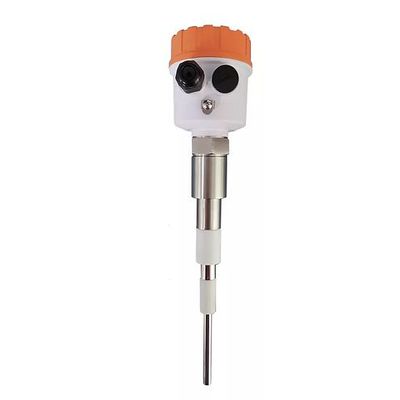
HYKO - Model RF -Admittance Level Transmitter
HYKO RF admittance level measurement is a method of measuring the level of liquids and solids using radio frequency (RF) technology. It is a non-contact method of measurement, which means that the sensor does not come into contact with the material being measured.
The design of an RF admittance level sensor typically consists of a probe and a transmitter. The probe is mounted at the top of the tank or silo, and is typically made of plastic or metal. The transmitter is located near the bottom of the tank or silo, and contains the electronics required to send and receive the RF signal.
The working principle of an RF admittance level sensor is based on the principle of admittance, which is the ability of a material to allow an alternating current (AC) to flow through it. The probe sends out an RF signal, which travels through the air to the surface of the liquid or solid. When the RF signal reaches the surface of the liquid or solid, some of it is absorbed, and some is reflected back to the probe. The ratio of the absorbed to reflected signal is used to calculate the level of the liquid or solid.
Some benefits of RF admittance level measurement include:
- Non-contact measurement: RF admittance level measurement is a non-contact method of measurement, which means that the sensor does not come into contact with the material being measured.
- Immunity to dielectric constant: RF admittance level measurement is not affected by the dielectric constant of the material being measured, which means that it can measure level of a variety of materials.
- Immunity to environmental factors: RF admittance level measurement is not affected by environmental factors such as foam, dust, or steam, which makes it suitable for use in harsh industrial environments.
RF admittance level measurement is a non-contact method of measuring the level of liquids and solids using radio frequency technology. The sensor sends out an RF signal, which is absorbed and reflected back from the surface of the liquid or solid, and the ratio of the absorbed to reflected signal is used to calculate the level. This method is not affected by dielectric constant and environmental factors, making it suitable for harsh industrial environments.
- Ideal for use in both liquids and bulk solids.
- Rugged construction for the roughest industrial applications. These products perform in high temperature, high pressure, high vibration, dirt and sludge and many other applications requiring sturdy, high-quality design.
- Solid-state electronic sensing has no moving parts.
- RF technology ignores significant product build-up on the probe.
- Simple installation and calibration.
- The probe length is easily modified.
- The modular electronics are easily serviced.
- Explosion-proof housing is standard.
- Customizable for extreme applications.
- Application: Liquid / Solids
- Pressure: 0.1 to 2MPa
- Temperature: 35 to 65 Deg C
- Accuracy: +/-0.5%
- Protection Class: IP65/IP67
- Output: DPDT Relay
- Power Supply: 220VAC / 24VDC
- Housing: Aluminium Die Cast
- Protection Grade: Explosion proof version available
- Cable Entry: M20x1.5
- Process Connection: Thread / Flange
- Sensor Material: SS304/ PTFE
- Anti-Viscosity
- Easy Installation
- Stable; Not affected by temperature
- Time delay function from 0-30 seconds
- IP65 housing protection
- 5 Amp output DPDT
- Highest temperature tolerance of 180 C
- High/low failsafe
- Applicable in liquid, syrup, solid, powder, and interface detection
- Alarm testing
RF admittance level measurement can be used in a wide range of industrial applications, including:
-
Storage tanks and silos: RF admittance level measurement is suitable for use in large storage tanks and silos, as it can measure level over long distances and is not affected by the dielectric constant of the material being measured. This makes it ideal for measuring the level of liquids and solids in tanks and silos used in the oil and gas, chemical, and food and beverage industries.
-
Process vessels: RF admittance level measurement can be used to measure the level of liquids and solids in process vessels, including reactors, distillation columns, and crystallizers.
-
Bulk solids: RF admittance level measurement can be used to measure the level of bulk solids in hoppers, bins, and chutes. This makes it suitable for use in industries such as mining, power generation, and cement production.
-
High pressure and temperature applications: RF admittance level measurement can handle high pressures and temperatures, making it suitable for use in harsh industrial environments. This makes it ideal for use in applications such as high-pressure boilers, autoclaves, and pressure vessels.
-
High-accuracy applications: RF admittance level measurement is highly accurate and provides precise measurements, making it suitable for use in applications that require high-accuracy level measurement, such as in laboratories and research facilities.