- Home
- Companies
- Rohde & Schwarz
- Products
- R&S - Aerial Monitoring System (AMS)
R&S - Aerial Monitoring System (AMS)
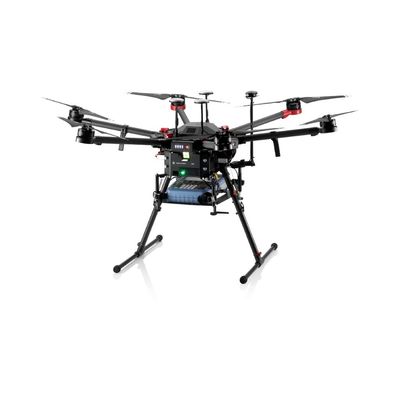
The R&S®AMS aerial monitoring system is a payload for drones that provides monitoring and analysis capabilities for VHF/UHF/SHF transmissions that are difficult to reach by conventional mobile or handheld solutions. Typical applications include monitoring of microwave links and interference hunting in dense urban environments.
- Aerial monitoring and interference hunting
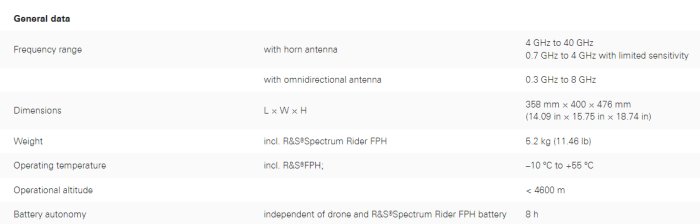
- Frequency range from 300 MHz to 40 GHz
- Automatic and interactive measurement procedures
- Independent of drone model and drone infrastructure
- Evaluation and reporting in R&S®ARGUS
Monitoring of microwave links
Key parameters for every transmission are center frequency, occupied bandwidth and level. The integrated spectrum analyzer measures multiple frequency bands of interest, displays the spectrum with high resolution and calculates the occupied bandwidth for each signal in line with the ß % me as recommended by the ITU.
Superimposing reference data, e.g. based on spectrum management information, clearly reveals whether thresholds are exceeded.
Another aspect in verifying license compliant operation is to validate that the transmitter uses the correct polarization. Comparing the spectra measured, e.g. with horizontal and vertical polarization, indicates the signal’s actual polarization. Together with its nominal polarization proper operation is verified.
In addition to enabling a detailed look at selected signals, the aerial monitoring solution is also a ve efficient tool to quickly obtain a comprehensive overview of a large part of the spectrum. It will sho the true spectrum usage and help detect unoccupied frequencies that might be assigned to further transmitters.
Interference hunting
Interference is a major issue also in the microwave range.
Analyzing the spectrum will reveal typical causes like adjacent channel interference or broadband noise. Once the interfering signal has been identified, the analyzer can tune to its frequency and the drone performs a 360° rotation in azimuth. The angle at which the highest level value is obtained indicates the direction towards the source of interference. Via the drone`s camera it might even be possible to recognize potential origins.
In the VHF/UHF range, detection and coarse location of interference sources are efficiently done by conventional monitoring solutions. The big challenge is to determine the precise location, so that the interfering signal can be switched off. Especially in dense urban areas, common phenomena like reflection, refraction or multipath propagation impair the precision of classical location solutions. An aerial solution like the R&S®AMS is much faster and more efficient. Pointing the directional antenna towards the building, it flies a systematic pattern along the front of the house, covering each floor and section. A look at the live spectrum displayed on the control laptop will very soon show behind which window the interfering transmitter is located. For this task, a second antenna covering the frequency range from 300 MHz to 8 GHz is available as an option.
Operation
For a maximum of operational flexibility, the R&SSAMS provides two different modes of operation: automatic and interactive.
Automatic operation
In automatic mode, multiple measurements are preconfigured via the integrated R&S®AMS-SW control software, e.g. by a monitoring expert in the office. Switching on the system at the actual measurement location will initiate a system check. On successful completion, the configured tasks will start immediately and the measured data are stored on the internal hard disk of the R&S®AMS control PC. There is no monitoring operator required, just a pilot who navigates the drone. Back in the office, the monitoring expert can analyze the data and compile comprehensive reports. Interactive operation
In interactive mode, a monitoring expert and a drone pilot are at the measurement site. A network connection from the operator`s laptop to the R&S®AMS control computer is established using the internal Wi-Fi. Via this link the measurements are defined and controlled. The live spectrum is displayed on the operator`s screen. This way the operator can if necessary react immediately by (re-)configuring and starting/stopping the measurements. The operator can save the results on the internal hard disk of the R&S®AMS control PC.
System aspects
The R&S®AMS payload includes an SHF antenna, a GNSS receiver and antenna and a control PC with a power supply, all integrated into the frame attached underneath the drone. The computer runs the control software that commands the R&S®Spectrum Rider FPH handheld spectrum analyzer to perform the measurements. All data is saved to the R&S®AMS control PC`s internal SSD. Thanks to the integrated communications module, it is possible to control the measurements and observe the live data on a PC on the ground.
The standard horn antenna covers a nominal frequency range from 4 GHz to 40 GHz. It can also be used from 700 MHz with reduced sensitivity. Additionally, the R&S®AMS-OMNI1 omnidirectional antenna with a frequency range from 300 MHz to 8 GHz is available as an option. For both antennas, the polarization can easily be changed by rotating the antenna while the drone is still on the ground. Power is supplied via a battery pack. It is the same type as the one used in the R&S®Spectrum Rider FPH. A battery charger is included.
The payload is securely connected to the drone via dronespecific brackets. Rohde & Schwarz recommends standard drones to which the payload can be directly attached. For other drones mechanical adaptations might be required, which are available on request. Due to the rapidly changing drone market, please contact Rohde & Schwarz for an up-to-date list of supported drone models.