

- Home
- Companies
- Aerosol Magee Scientific Company
- Products
- Magee Scientific - Model AE33 - ...
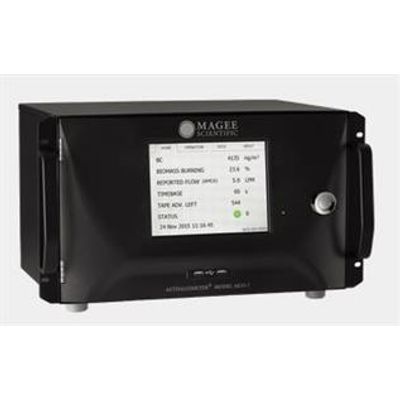
Magee Scientific - Model AE33 -Aethalometer
The Aethalometer is the instrument most-used in the world for the real-time measurement of aerosol Black Carbon. The Model AE33 is the culmination of almost 40 years of experience and development. It provides accurate data with aerosol speciation on time-scales as rapid as 1 second, using our patented DualSpot™ technology and multi-wavelength optical analysis.
The Model AE33 ‘Next Generation’ Aethalometer incorporates scientific and technical advances which offer improved measurement performance, user features, networking and communications. The ‘Neutral Density Optics Kit’ provides a validation of the analytical performance that is traceable to fundamental standards. Built-in test programs offer routine checks of performance and stability. These features provide the Quality Assurance that is essential for routine monitoring and research use.
The Aethalometer collects and analyzes aerosol particles continuously. The aerosol-laden air stream is drawn through a spot on a filter tape at a measured flow rate. Simultaneously, the tape is illuminated by light: and sensitive detectors measure the intensities of light transmitted through an un-exposed portion of the tape acting as a reference; versus the collecting spot. As optically-absorbing material accumulates on the spot, the intensity of light transmitted through it, gradually decreases. The decrease in light intensity from one measurement to the next is interpreted as an increase in the amount of collected material. This increase amount is divided by the known air-flow volume to calculate the concentration.
In the new Model AE33 Aethalometer, two sample spots are collected from the same input air stream with different rates of accumulation, and analyzed simultaneously. The two results are combined mathematically to eliminate the “Filter Loading Effect” nonlinearity, and provide an accurate measurement of the aerosol concentration.
Additionally, the analysis is made at 7 optical wavelengths spanning the spectrum from 370 nm to 950 nm. Increases of optical absorption at shorter wavelengths may be interpreted in terms of the presence of so-called “Brown” carbonaceous material, usually an indicator of emissions from biomass combustion.
The Model AE33 Aethalometer has been developed with input from the research and monitoring communities, and is designed for reliable operation under all conditions ranging from state‐of‐the‐art research to routine air-quality monitoring.
The Model AE33 Aethalometer incorporates the patented DualSpot™ measurement method. This completely solves the loading-dependent nonlinearity which affects the data from any filter-based optical analyzer. The method explicitly does not require any knowledge or assumption about the existence, origin or magnitude of any optical nonlinearity: in fact, the calculation yields the “Loading Compensation Parameter” as an instrumental data output, which may offer insights into the origins and optical properties of the aerosol.
The analysis is performed at 7 optical wavelengths spanning the range from the near-infrared (950 nm) to the near-ultraviolet (370 nm). The sequencing of illumination and analysis is performed on a 1-Hz timebase. This yields the complete spectrum of aerosol optical absorption with one data line every second.
An Ångström Exponent model is used in real time to calculate the fraction of BC that may be attributed to biomass combustion.
The optical performance of the Model AE33 Aethalometer may be validated by the ‘Neutral Density Optical Filter Kit’, consisting of four precision optical elements whose absorbance is traceable to fundamental standards. Software routines measure the optical intensities at all wavelengths and compare the analysis at the instant with the original reference values. Other built-in test programs offer routine checks of stability and leakage. These features provide the Quality Assurance that is essential both for routine monitoring and research use.
User and communications interfaces permit remote monitoring of operation; data retrieval; performance of internal tests; and reporting of ‘state‐of‐health’ parameters. Networked services offer automated status reports, issuing daily ‘Green’ reports when the instrument is functioning correctly; ‘Yellow’ reports when the instrument detects that it will need routine attention soon; and ‘Red’ reports immediately upon detecting any fault condition.
The Aethalometer has been developed over almost 40 years to offer rugged, reliable, and automatic operation. The Aethalometer recovers automatically from power interruptions and no operator attention is required for weeks or months, other than replacing the roll of filter tape.
- Supply voltage: 100-240 V~, 50/60 Hz
- Max power consumption: 90 W. Typical power consumption: 25 W
- Measurement wavelengths: 370, 470, 520, 590, 660, 880 and 950 nm
- Air flow: set-points of 2, 3, 4 and 5 LPM
- Indoor or sheltered use only: the Aethalometer is not weatherproof.
- Altitude: up to 3000 m with internal pump. Increased flow at very high altitudes possible with external pump on request.
- Temperature range: 0 – 40 degrees Celsius (instrument)
- Relative humidity range: non-condensing. Note that it is essential to prevent condensation of humid outdoor sample air, if the instrument is located in a chilled (air-conditioned) environment.
- Chassis material: sheet metal
- Dimensions: standard 19”/6U, rack mount
- Weight: approx. 20 kg
- Sampling air: inlet / outlet type – ¼” NTPF
- Communication: 3x USB type A, 3x COM, 1x Ethernet
- 8.4” SVGA display with LED backlight
- Basic control: touch-screen
- Optional control: standard PC keyboard and mouse via front-panel USB ports.
- Red, Yellow, Green status LEDs