


- Home
- Companies
- Aircon Corporation
- Products
- Aircon - Baghouses
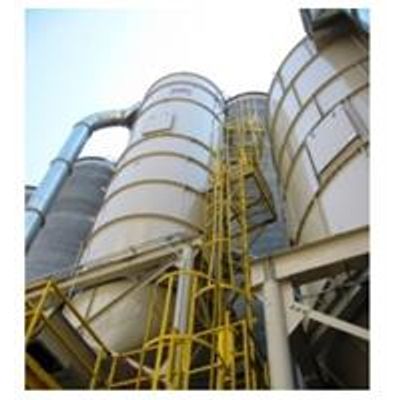
Aircon - Baghouses
A baghouse is a dust collection devices that filter air by passing it through a cloth or synthetic fiber media (or bag). A bag is a long cylinder-shaped envelope that collects dust on its exposed surface. Baghouses differ not by the method by which dust is removed from the airstream but rather by the method by which dust is removed from the bag.
If used in conjunction with a cyclone, a baghouse is used as an after filter and located downstream. Baghouses are necessary for air filtration, not scrap collection. Unlike the cyclone, the fine paper dust collected from a baghouse has no value in recycling. Baghouses are necessary where moderate to stringent emission control measures are in place. In addition to its environmental value, a baghouse may reduce winter heat loss if conditioned air is passed through the baghouse and recirculated back into the facility. Unlike a cyclone, a baghouse can support the cleaning efficiency necessary to direct its outlet air back into the plant.
Given an air capacity, a baghouse often may be selected based on a set air-to-cloth ratio. The air-to-cloth is not actually a dimensionless “ratio”. In the U.S. system of units it equals the average filtration velocity (feet per minute or fpm) which is the system capacity (cubic feet per minute or cfm) divided by the cloth area (square feet). Although air-to-cloth ratio standards differ from user to user, their usual range is from 5:1 to 10:1, with 8:1 as the most common.
Although the air-to-cloth ratio is an essential design parameter, it is not more important that a manageable interstitial velocity. The interstitial velocity is the velocity of the unfiltered air traveling upward in between the bags. This velocity is greatest near the base of the bags, before any air is absorbed through the media. The maximum interstitial velocity can be calculated by dividing the cfm filter capacity by the horizontal cross sectional area of the unit, counting only the area outside of the bags. If this value is too large (over 400 fpm), it will prevent dust from falling below the elevation of the baghouse air inlet. The dust particles that have been blown (or pulsed) away from the dust layer on the bags will become entrained in the upward moving airstream and forced back toward the surface of the bags. Fine paper dust is especially susceptible to this, even at low interstitial velocities (over 200 fpm).