
The angle of incidence to the substrate affects the rate and uniformity. One of the many benefits to the eccentric, off axis milling configuration is the reduced ion source size necessary to achieve uniform etching of larger wafers which would typically require costly, larger sources to achieve similar uniformity results. Angular incidence also improves removal rates while reducing damage to the substrate.
In addition to the milling angle, ion beam energies are a key component of milling rates. Depending on the ion source selected, ion energy can vary from 50-1200 eV allowing for a wide range of milling applications. For heavier milling requirements, higher ion energies are commonly desired. Lower ion energies are better suited for more sensitive substrates.
During the milling process, an increase of the substrate temperature can affect the milling rate and composition of material. Stabilizing the substrate temperature during the milling process is desired in order to maintain a consistent rate and uniformity and prevent substrate damage or unwanted modification.


- Home
- Companies
- AJA International, Inc.
- Products
- AJA International - Model Orion IMS ...
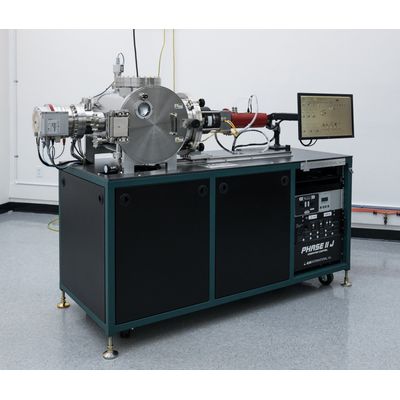
AJA International - Model Orion IMS Series -Ion Milling Systems
AJA International, Inc. offers the ATC Orion Series Ion Milling Systems, designed for high performance in cost-effective settings. These systems feature cylindrical chambers with large hinged doors for easy access and maintenance. A key feature is the substrate holder, capable of handling up to 4-inch wafers with capabilities such as azimuthal rotation, motorized tilt adjustment, and cooling options using H2O, LN2, and backside gas cooling. The system incorporates sputter sources for passivation layers, SIMS end-point detection, and includes gridded DC ion sources ranging from 1 to 8 cm. The ion sources can be configured for high-rate applications or sensitive low-energy processes, using DC/RF Kaufman style or RF sources with grounded grids. Angular incidence reduces source size for uniform etching, improving removal rates with minimized substrate damage. Ion energies range between 50-1200 eV, accommodating diverse milling applications. The system is equipped with UNO Series Substrate Holders for cooling and phase II-Au computer control for comprehensive process management.AJA International, Inc. ATC Orion Series Ion Milling Systems are durable, compact tools designed to deliver maximum performance for limited budgets. Chambers are cylindrical in design with a large hinged door for ease of access for operation and/or routine maintenance. System utilizes a substrate holder with up to 4” wafer handling with various capabilities including azimuthal rotation, motorized tilt adjustment, and cooling capabilities (H2O, LN2, Backside Gas Cooling). Additional features include sputter source(s) for passivation layers, SIMS end point detection, and gridded DC ion source ranging between 1-8cm in size.
AJA manufactures and utilizes the leading ion sources on the market in all of the ATC-Series Ion Milling Systems. Systems are fitted with either DC/RF Kaufman style sources for high rate applications or capacitively/inductively coupled RF ion sources with grounded grids for sensitive, low energy applications. DC sources are typically employed for non-reactive milling (Ar only) and include exposed filament neutralization. RF ion sources are compatible with inert and reactive gases. Depending on the application, sources can be positioned in the chamber for direct or angular incidence to the substrate.