
- Home
- Companies
- Ikeuchi Europe B.V.
- Products
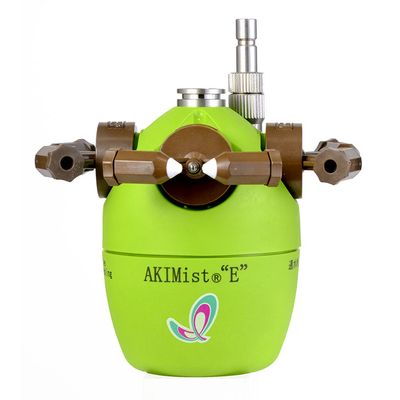
- AKIMist - Model E - Dry Fog Humidifier
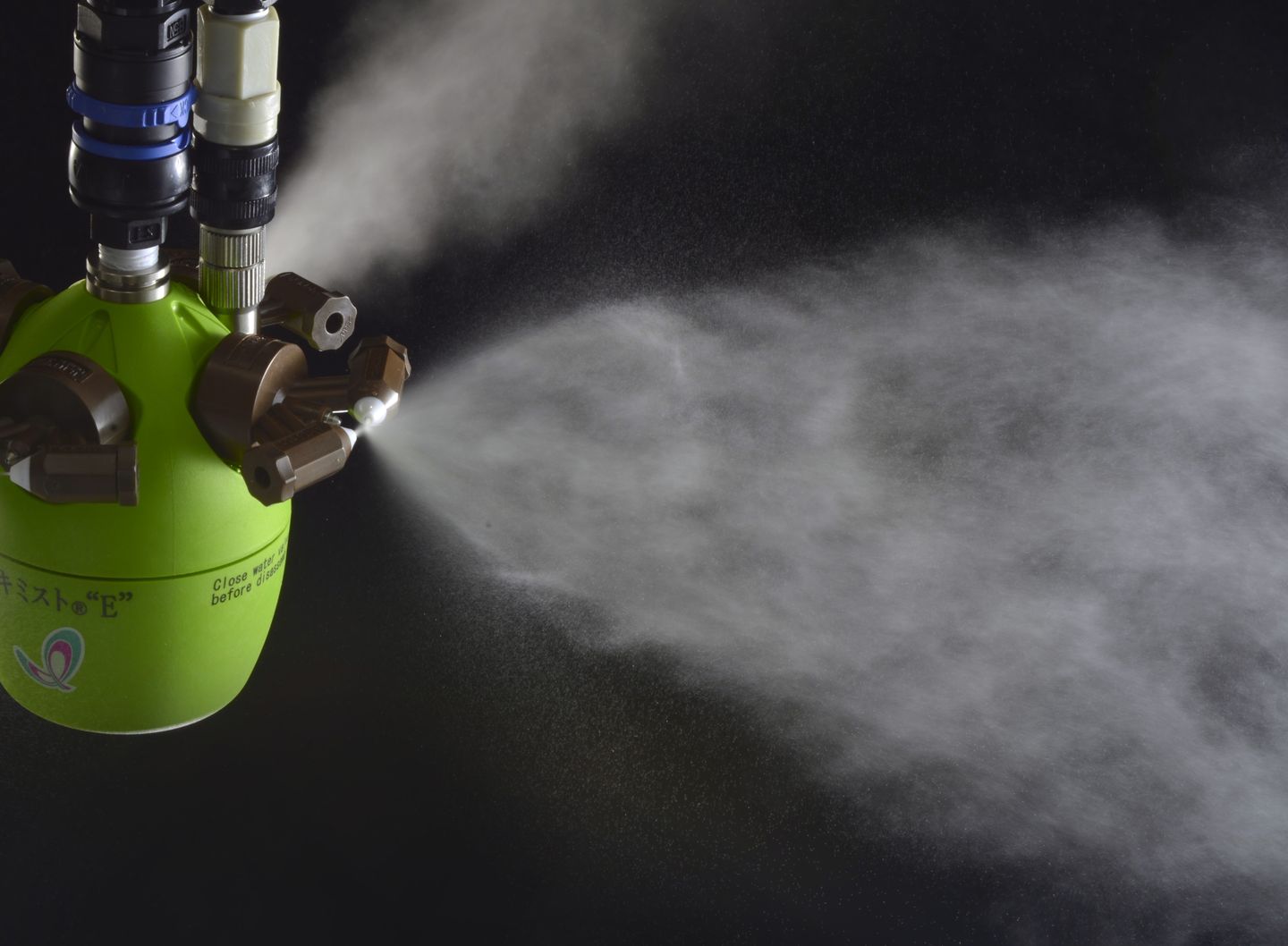
This technology differs from other impingement nozzles, as it is produced through the impact between two fine fog jets that further break down the water droplet to an even finer fog (dry fog).
The nozzle spacing and pressure outside the nozzle are key to producing this Dry Fog spray that does not wet. This is an original method developed by IKEUCHI.
This method integrates an exterior mixing type of air-liquid system, as the compressed air and the liquid mix outside the nozzle. Thus, this impinging type of nozzle clogs the least in the range of pneumatic nozzles.
Our systems are consist of a humidifier and its ancillary devices, such as RO units (for filtration and demineralization of the water) and control panels (for spray flow and drip controls). Together as singular unity, they provide humidification for various applications and industrial operations accurately and efficiently.
- Energy-efficient humidifier with pneumatic spray nozzles producing Dry Fog**.
- Through world-leading technology, our AKIMist ® “E” produces ultra-fine non-wetting Dry Fog, which does not wet the objects it touches.
- It prevents dryness and static electricity, enabling higher manufactured product quality and lower defect rates.
- Its running cost is 1/5 of a comparable steam humidification system.
- For spaying chemical solutions or disinfectants, we recommend the chemically-resistant AKIMist ® “E” TN.
** We define Dry Fog as a very fine fog with a uniform mean droplet diameter (mean fog droplet size) of 10μm or less. Because Dry Fog’s exceedingly fine spray droplets remain intact without bursting when they come into contact with objects such as walls and people, they do not wet the impacted surfaces nor the nearby environment. “Dry mist,” despite its similar name, has much larger droplets than Dry Fog and has no specified droplet diameter as part of its definition. Dry mist droplet sizes vary significantly by producer and product.
- Spray volume per one AKIMist®“E” with nozzle type 03C at a standard pressure of 0.3 MPa. It varies from nozzle type. AKIMist®“E” with nozzle type 04E in stainless steel: 3.0 – 12.0 L/h
- Sauter mean droplet diameter of AKIMist®“E” with nozzle type 03C. It varies from nozzle type. AKIMist®“E” with nozzle type 04E: 10μm
- Air consumption of AKIMist®“E” with nozzle type 03C. It varies from nozzle type. AKIMist®“E” with nozzle type 04E: 36 – 144 L/min, Normal
Depending on the type of application and use, the AKIMist ® “E” Dry Fog Humidifier can be offered with mounting kits and UT adaptors. These accessories assist in facilitating its installation and the spraying angle and direction.
Moreover, additional cleaning kits are provided, as the nozzles do not incorporate self-cleaning nozzle technology. Even in the case of demineralized water usage, the nozzle tips need regular cleaning. This way, you ensure that the environmental dust particles are removed and do not interfere with nor affect the atomization.
- Static electricity prevention: Prevents/reduces the possibility of static electricity discharge to occur, combating against issues such as product damage and debris/dust adhesion, etc.
- Energy-saving: The running costs of our system are only 1/5 of a typical steam humidification system, resulting in considerable energy savings.
- Cooling effects: The system also yields a cooling of about 2?, reducing temperatures with evaporative cooling (using the principle of heat loss due to water evaporation of Dry Fog).
- Health-related benefits: Maintaining a relative humidity level of around 50%, which reduces cold viruses, influenza (flu) viruses, etc., thus increasing the well-being factors of the employees.