


ISS, Inc.
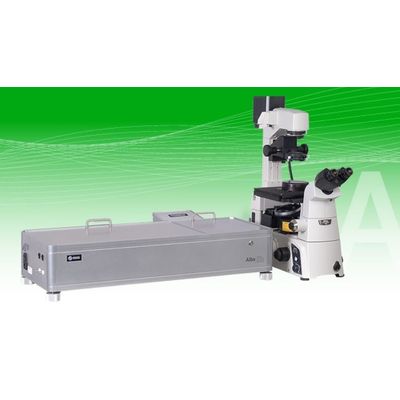
Alba STED - FLIM/FFS Laser Scanning Nanoscope
FromISS, Inc.
The instrument for quantitative cell biology at single-molecule detection. Stimulated Emission Depletion (STED) is a powerful microscopy technique that allows for the observation of fluorescence structure with spatial resolution below the diffraction limit. The Alba-STED uses the pulsed excitation and pulsed depletion approach (pSTED) in combination with the digital frequency domain fluorescence lifetime imaging (FastFLIM) to record the time-resolved photons which allows for an increase in the image resolution and the separation of two labels with the same excitation wavelength.
Most popular related searches
fluorescence imaging
sample holder
hybrid stepper motor
cell biology
petri dish
laser scanning
microscopy
fluorescence spectroscopy
inverted microscope
optical separation
- pSTED (Pulsed excitation and pulsed STED)
- FastFLIM for time-resolved pSTED acquisition
- Improved image resolution using the phasor plot
- Dual-label excitation
- Fast image acquisition (dwell time: 0.2 µs)
- High dynamic range (signal up to 60 million counts/s)
- 1p or 2p confocal images
- FLIM Fluorescence Lifetime Imaging (FastFLIM)
- PLIM, Phosphorescence Lifetime Imaging
- Polarization images
- Fluorescence Fluctuations Spectroscopy (FCS, FCCS, PCS, FLCS)
- RICS, N&B, Scanning FCS
- Burst Analysis
- FRET efficiency determination
| Instrument Features |
|
| Acquisition and Analysis Software |
|
| STED laser | Pulsed, 775 nmAverage output power: 1 W Pulsewidth: about 600 ps Repetition rate: 0-100 MHz; or Ext. CLK Beam quality: M2 < 1.1, TEM00 Amplitude noise: < 4.0% rms |
| Excitation laser | Pulsed, 640 nmPulsewidth (at medium power): 40-90 ps Repetition rate: 20, 50, 80 MHz; or Ext. CLK Power (at 50 MHz): up to 5 mW |
| Laser Launcher |
|
| FastFLIM |
|
| Microscope |
|
| Objectives |
|
| Stages |
|
| Sample Holders |
|
| Light Detectors |
|
| Image acquisition | FLIM acquisition: 0.2 µs dwell time |
| OS Requirements |
|
| Power Requirements |
|
| Dimensions |
|
| Weight |
|