


- Home
- Companies
- AMETEK Scientific Instruments / ...
- Products
- AMETEK - Model 1255B - Frequency ...
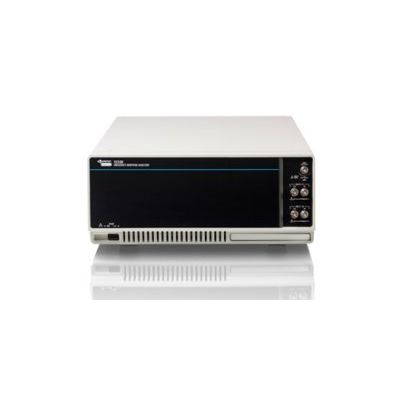
AMETEK - Model 1255B -Frequency Response Analyzer
Wide frequency range from 1 MHz to 10 µHz. Sine wave Voltage generator to 3 V RMS and ± 40.95 V DC. Two (2) Voltage measurement channels to 5 V peak. Able to perform DC potentiotstatic and galvanostatic experiments with 1287A Electrochemical Interface. Impedance range from 100 mOhm to 100 TOhm, with the 1296A Dielectric Interface.
Frequency Response Analysis (also referred to as Transfer Function Analysis) measures the output spectrum of a system relative to a stimulus, and is used to characterize the dynamics of the system under test. The technique measures the magnitude and phase relationship between output and input waveforms as a function of frequency. The input signals may be from a wide range of sensors including acoustic (microphones/sonar), mechanical (accelerometers/displacement transducers), optical (photodetectors), and electrical (amplifiers).
Applications that make use of this powerful technique include - electrochemical impedance spectroscopy (EIS), materials analysis, aerospace control system design, electronic amplifier design, power supply design, and vibration analysis.
The 1255B Frequency Response Analyzer is one of a range of instruments that will meet your needs today and in the future.
Using the single sine technique the 1255B provides precise measurement of gain and phase between any two points in a system. This fully digital technique is used to assess the performance of both simple and complex systems - electrochemical, materials, electronics, mechanical, and acoustic.
For over 45 years Solartron Analytical have produced frequency response analyzers, instruments which are regarded throughout the world as industry standards. This unsurpassed knowledge and experience has been used to produce the 1255B, with its 1MHz frequency range and 1 in 65 million frequency resolution.
The 1255B Frequency Response Analyzer applies the power and sophistication of modern measurement technology; simple in concept, fast and precise in performance, and so easy to use, even by non-technical personnel.
Electrochemistry
Measurement of impedance has become an important tool in the study of electrochemical/biological phenomena and material properties. The 1255B together with a potentiostat such as 1287A can be used in a wide range of applications, including:
- Corrosion and corrosion protection
- Properties of organic and inorganic coatings and films
- Development of solid electrolytes for oxygen sensors
- Development of novel anode/cathode materials and electrolytes
- Studies of animal and plant tissue properties
- Photoelectric effects
Materials Testing
When combined with a 1296A Dielectric Interface and temperature test equipment the 1255B can be used to test a wide range of materials, such as:
- Fuel cell and solid state batteries
- Relaxation processes in the molecular dynamics of liquid crystals, polymers and liquids
- Charge transport in semiconductors, organic crystals, ceramics etc.
- Analysis of chemical reactions, polymerization and curing processes
- Novel gas and liquid sensors
- Characterization of insulating and semiconductor materials
- Quality control in the production of insulators, printed circuit boards, etc.
Electronic Testing
1255B is ideally suited to a wide variety of applications in the field of electronics - from fundamental aspects, such as the characterization of the electrical and mechanical properties of materials, to the development and testing of components and complete circuits.
Generally these applications require the measurement of transfer functions and group delay over a wide frequency range. In the case of amplifiers or filters, a wide dynamic range coupled with high frequency resolution are also needed to enable the attenuation characteristics to be full defined.
Mechanical Testing
Mechanical Tests include aerospace applications such as servo systems, guidance control systems, acoustic systems.