

- Home
- Companies
- AMETEK Process Instruments
- Products
- AMETEK PI - Model 930 - H2S in Sulfur ...
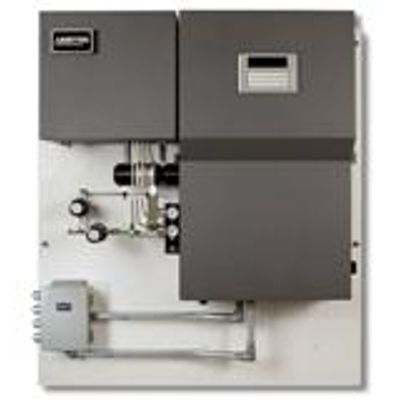
AMETEK PI - Model 930 -H2S in Sulfur Pit Analyzer
Using proven ultraviolet (UV) technology, the 930 identifies potential safety risks in sulfur storage locations through simultaneous hydrogen sulfide (H2S) and sulfur dioxide (SO2) measurements. Capable of stable, sensitive measurements ranging from parts-per-million (ppm) to percentage levels, the analyzer offers output alarms for the lower explosive limit of H2S and smoldering fire level of SO2.
The 930 analyzer samples the vapor space gas using reliable UV technology. The sampling system has a sulfur knock-out at the probe to eliminate entry of excess sulfur vapor or liquid into the system.
Sharing a common design with the 900 (air demand) and 910/920 (stack gas) analyzers, the 930 provides simultaneous safety measurements for sulfur recovery and de-gassing in the hydrocarbon processing industry.
MINIMAL BASELINE AND SPAN DRIFT
The 930’s dual-beam configuration, combined with the reference measurement, ensures low noise performance with minimal baseline and span drift. Measurements from ppm to percent level are possible.
SIMULTANEOUS MEASUREMENTS
A multi-component UV analyzer, the 930 is configured to measure both H2S and SO2 in the sulfur pit at the same time.
ASR900 PROBE OPTION
The ASR900 advanced sulfur reduction sampling probe uses a temperature-controlled sulfur condenser, providing sulfur vapor control at the sample point. This ensures no plugging will occur in the sample lines and analyzer.
The 930 is the sulfur pit analyzer designed to ensure safety through accurate H2S and SO2 measurements – Find out more.
- Common design with 900 and 910/920 analyzers
- ppm to percent level measurements
- Exceptional baseline stability and sensitivity
- ASR900 probe prevents sulfur plugging
- Methodology: Multiple wavelength, high resolution, nondispersive UV
- Typical Range: 0 to 4% H2S, 0 to 2% SO2 (other ranges available on request)
- Accuracy: Better than 1% full scale
- Repeatability: Better than 0.5% full Scale
- Linearity: Better than 1% full scale
- Response Time: Typically less than 30s to T90 (excl. sample system)
- Sample Transport: Air aspiration
- Typical Sample Flow: 3 to 5 L/min (0.1 to 0.2 CFM)
- Temperature Control: Independent control of four zones (oven, sample line, probe, vent line)
- Ambient Temperature: 5° to 50°C (41° to 122°F)
- Instrument Air: Minimum 413.6KPa (60 psig), 120 L/min (4.24 CFM), instrument quality air
- Power: 120 VAC ±10%, 47-63 Hz or 240 ±10%, 47-63 Hz; 600 W for analyzer only excluding sample and vent line and ASR probe
- Analog Outputs: 4 to 20 mA self-powered (optional loop-powered), maximum of 4
- Communications:
- RS422 with Modbus protocol
- RS485 optional
- Ethernet optional
- Relays 3 independent sets of SPDT relays alarm conditions
- Physical Dimensions: 1553.6 x 1117.6 x 306 mm (61.17 x 44 x 12 in.)
- Weight: Estimated minimum 160 kg (350 lbs)
- Approvals and Certifications:
- NEC/CEC Class I, Division 2, Groups C & D
- ATEX II 2G EEx pd IIB T3
- Russian Ex Proof Certification; 1ExpydIIBT3
- Russian Gosstandart Pattern Approval
- Complies with all relevant European Directives
- NEC/CEC Class I, Division 2, Groups C & D
- ATEX II 2G EEx pd IIB T3
- Russian Ex Proof Certification; 1ExpydIIBT3
- Russian Gosstandart Pattern Approval
- Complies with all relevant European Directives