


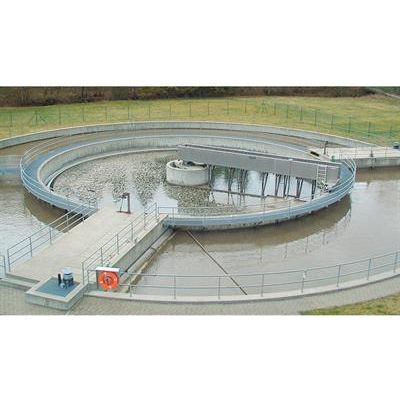
Intech - Aqualogic & Enerlogic Plant
Aqualogic control systems offer customized solutions to individual optimization tasks in the operation of sewage treatment plants. They enable flexible use of the required measuring technology and achieve optimal discharge values coupled with low energy consumption and reduced operational costs. Enerlogic ensures maximal aeration energy savings while simultaneously achieving best cleaning performance and stable plant operation.
Unique Selling Point
- Scalable for every plant size
- Able to use sensors of different suppliers
- Highly flexible
- Usable for all plant sizes and nearly all process types
- Modular program structure - functions/modules can be added step by step.
- Load-dependend oxygen set point
- Sludge age control
Insights
The load fluctuates considerably in sewage treatment plants as a result of customary daily use, seasonal influences and commercial inflows. Natural events, such as rainfall or periods of drought also lead to peak load and low load periods which call for flexibility of action. Aqualogic® control systems calculate the ideal regulation for individual operational units on the basis of Fuzzy Logic.
This mathematical method, which is modelled on our human way of thinking, can meet the most diverse demands due to its creation of an ideal operational performance. The partially conflicting requirements of the various cleaning processes can thus be optimally met and, for example, intermittent or continuous aeration achieved. The high level of transparency and ease of operation of Aqualogic® enable the user to adapt the system and include experiences previously gained.
Aqualogic® is flexibly adjusted to both existing and desired measuring technology. Many operating companies opt for a regulation of oxygen input by means of the measuring signals oxygen, temperature, ammonium and nitrate. Further signals (such as e.g. feed volume, phosphate, filling level, etc.) can be practically integrated according to the specific application, in order to meet the demands of more complex systems.
Moreover, the organic load can be determined by means of the integrated consumption controller and optimal carbon denitrification ensured. A simple control variant based on oxygen, redox potential and temperature is also possible for smaller plants.
The scope of an Aqualogic® installation is determined by the requirements of the wastewater treatment plant and the needs of the operating company. The Aqualogic® software can be installed on an existing process control computer and easily integrated into the existing automation level of the plant. In addition to the software, complete system solutions can also include PC and SPS technology and also sensor, air blower, conduit and aeration technology.
The Enerlogic® control software is modular designed and configured to suit the specific requirements of each individual wastewater treatment plant. Existing Aqualogic® systems can be converted easily to Enerlogic®. Important input variables in this context are ammonia and nitrate concentrations in the activation stage and frequently the solids concentration. In addition to a variation of aerated and non-aerated phases that meets needs as closely as possible, Enerlogic® also serves to vary the oxygen concentration in the activation phase according to loading, which further optimizes energy input. This means that, for example, during night-time off-peak periods or in the event of longer rain fall, the activation of many plants can be carried out with significantly lower oxygen concentrations.
Furthermore, Enerlogic® also takes into consideration the current basal metabolic rate of the microorganisms, i.e. the so-called endogenous respiration.
Dynamic sludge age regulation is available as another Enerlogic® module. It is used to set the dry solids content in the aeration tank fully automatically, depending on loading and temperature at a given time. Excessive dry solids content is effectively prevented. Depending on the system, considerable savings potential can be tapped, as each gram above the ideal dry solids content corresponds to an increase of approx. 10 % in additional aeration energy consumption.