- Home
- Companies
- Metrohm AG
- Products
- Autolab - Multichannel Line instruments ...
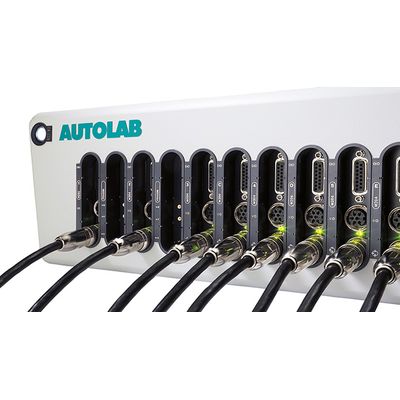
Autolab - Multichannel Line instruments - Electrochemistry Times Twelve
Take a fully functional poteniostat/galvanostat, multiply it by twelve, and you get a Multichannel instrument. Based on the PGSTAT101 and the PGSTAT204, the Multichannel instruments consist of a mainframe with up to twelve channels. As each channel is a separate potentiostat/galvanostat module, you can have one instrument that allows you to perform up to twelve measurements on just as many individual electrochemical cells.
-
Up to twelve potentiostat/galvanostat channels in one instrument
-
Complete range of accessories
-
Modular design
-
Shared control of the instrument
-
Designed to interface to any external instrument
-
Flexible software control
With a Multichannel Line instrument, you can combine a total of twelve potentiostat/galvanostat modules (M101 or M204) and extension modules in one system.
You can thus configure a customized system that is perfectly suited for your specific research requirements. Each of these up to twelve modules is capable of performing measurements in an individual measuring cell.
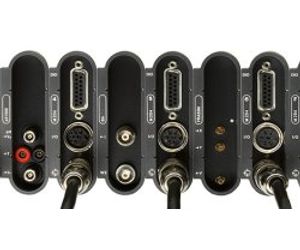
Like all Metrohm Autolab instruments, Multichannel line potentiostats/galvanostats can be interfaced to any external instrument and are controlled via the NOVA software. What’s more: They can be controlled by three different computers.
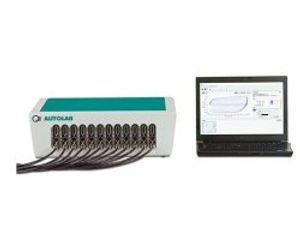
If necessary, you can expand the functionality of your Multichannel Line system even further by adding extension modules.
The Multichannel system can have up to six optional modules, each controlled by an M101 or M204 module.
Optional modules are:
- BOOSTER10A module for high-current applications
- FRA32M module for electrochemical impedance spectroscopy measurements
- BA module (dual-mode bipotentiostat module) converting the the instrument into a double-channel potentiostat for measurements on two working electrodes with the same counter and reference electrode
- pX1000 module for pH or pX value measurement during electrochemical experiments. With an additional Pt1000 input for temperature measurement
- EQCM module (Electrochemical Quartz Crystal Microbalance) to measure the mass change per unit area by recording the change in resonant frequency of a quartz crystal oscillator
- MUX module for sequential experiments on multiple cells or multiple working electrodes