


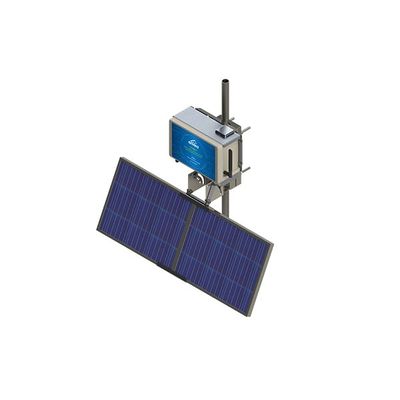
ENVEA - Model Cairnet 2020 -Autonomous Networks of Sensor-Based Mini-Stations
Cairnet® device is a real-time standalone and networkable air-monitoring station containing up to 6 Cairsens® microsensors and cellular communication within a waterproof enclosure. Thanks to its integrated manifold allowing a dynamic sampling, the measures are accurate and reliable. Electronic compounds are sealed & protected from moisture and corrosive ambient air.
Compact, easily deployable and autonomous thanks to its solar panels and battery, Cairnet® enables you to cost-effectively monitor dust and gas and gives a complete picture of the environmental impact of your operations.
It offers unprecedented flexibility in producing accurate and dynamic air quality measurements across a broad range of industries and applications.
- Odor monitoring: WWTP, recycling, pulp and paper manufacturing, sewerage treatment facilities, refineries
- Indoor and outdoor air quality monitoring: smart cities, road-side & tunnels, schools, airports, ship terminals…
- Process leak detection and monitoring of fugitive emissions: quarries, storage facilities, mines, manufacturing plants
- Forecasting of industrial fence line emissions
- Environmental impact assessments
- Health and safety: mines, industrial sites, construction
- Mapping and modelling pollution sources
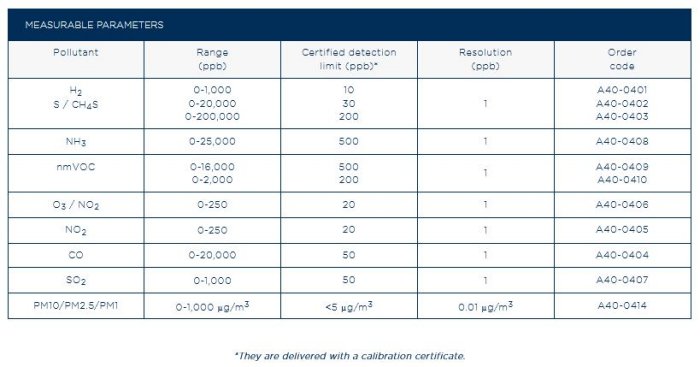
- Real time continuous measurement and monitoring of up to 6 gaseous and particulate pollutants simultaneously, among: H2S/CH4S, NH3, nmVOC, O3/NO2, NO2, CO, SO2, PM, plus environmental parameters: temperature, relative humidity and pressure.
- Plug & Play Network: no manual intervention, automatic detection, linking and configuration of the network (Cairsens® / Cairnet® / Caircloud®)
- Very high sensitivity to capture low level gas concentrations (down to ppb)
- Modular, easy to use, easy to move: no cables or complicated installation, just set up and move to different locations on your site as needed
- Cairnet® requires only annual maintenance, when sensors should be renewed with new ones
- Ability to change the set of pollutants being monitored at any time
- Advanced remote diagnosis with real tracking state of life
- Possibility to realize hybrid AQMS networks (reference stations & mini-stations)
- Operating cost savings: process adjustment & Improvement of local communication (neighbors & authorities)
- Cost-effective solution for air quality monitoring
Independent reviewers, including the European JRC (Joint Research Council) and the US-EPA, have determined the accuracy, linearity, limits of detection and precision of Cairsens® as very good when compared with reference devices. Further studies with NASA have shown very good agreement with reference measurements.
- Every Cairnet measurement point consists of:
- Solar panel and its battery
- Wireless communication module
- Weather protection enclosure including up to 6 Cairsens miniature sensors, each measuring one or two pollutants. The sensors are to be selected from the list, function of your specific requirements.
Technical specifications
- Power supply: 8 to 30 VDC / 2.5 A or battery + SP
- Battery included: 3.7V-22Ah, Li-Ion
- Solar Panels Kit (option): 27 Watts (with 2 panels). Mounting bracket included
- Control & Data Treatment Board: Internal microprocessor for data acquisition, power and communication managment etc…
- Embedded Real-Time-Clock (auto-adjusted at every communication)
- I/O Login & local communications: RS485/RS232 for Rtu Modbus, RJ45 for TCP-ip Modbus
- SDI12 for acquisition of weather parameters
- Wireless communication: Cellular 3G-, 4G LTE (SIM not included)
- Locally data storage: Internal Cairsens memory. Data buffering for back up if communication is lost
- Mounting included: Included for pole, tripod, mast, wall, etc. (⌀50 mm max)
- Dimensions of the Cairnet® housing with mounting kit & antenna: 300 x 215 x 257 mm (L x H x W)
- Dimensions of the solar Panels with its mounting kit: 800 x 410 x 100 mm (L x H x W)
- Weight of the Cairnet® housing: 4 Kg
- Weight of the Solar Panels kit: 4.9 Kg
- Environmental using conditions: -20°C to +50°C / HR 10% to 90%
Cellular communication characteristics:
- Technology and frequency bands: LTE (1800, 2100, 2600 MHz), WCDMA (800,1700, 2100 MHz), GPRS/Edge (850 MHz, 900 MHz, 1800 MHz, 1900 MHz)
- Download up to 100 Mbps, Upload up to 50 Mbps
- Regulatory compliance: R&TTE directive 1999/5/EC Japan JRF/JPA – FCC – IC
Site configuration and communication mode:
- Wireless / Cellular: suitable for large surface network deployments, industrials & urban sites covered by the network.
- Serial / Modbus: suitable for local spot monitoring for applications such as health and safety, process leakage detection or area not covered by telephone network