


- Home
- Companies
- AWT Global LLC
- Products
- AWT - Model S1L - PIM Analyzers for ...
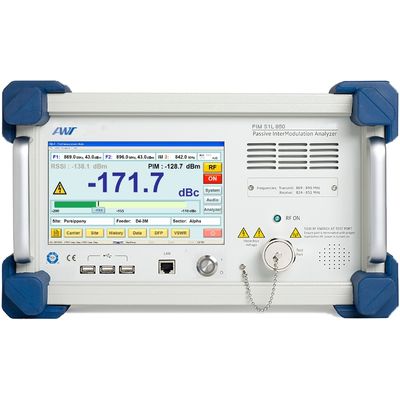
AWT - Model S1L -PIM Analyzers for Laboratory and QA
AWT’s S1L Series PIM analyzers are fully conform to PIM standard IEC62037. These PIM testers have a very low noise floor, are very sensitive and come with a wealth of other features. PS1L analyzers are the ideal PIM test equipment choice for laboratory and QA.
- Test Modes: Diagnostic, Analyzer with Graphs, Sweep Mode (option), Distance to PIM (option), Distance to Fault (option)
- Very high PIM sensitivity, up tp -172 dBc @ 2x 43 dBm carriers
- Output power variable from 15dBm to 44dBm
- Measures intermodulation products IM3, IM5 IM7, IM9, IM11, IM13 and IM15
- PIM over Time Graph and Sweep Mode
- Maxhold feature
- Data recording: CSV, PDF, Screenshot (BMP)
High quality, low PIM components are particularly important to achieve maximal network capacity. Signal degradation affects operator’s revenue streams due to reduced data capacity. Leading global manufacturers use AWT Global PIM analyzers to guarantee lowest PIM values of of their wireless components and products.
Passive Intermodulation – PIM
Passive Intermodulation (PIM) is an unwanted mixing effect caused by non-linearity of passive components in the RF path of telecommunication systems. PIM diverts signal energy to other frequencies (spurious signals). This can generate interfering signals that may fall into receiving bands causing serious degradation of system performance.
- Dissimilar metals with different electrical properties as well as corroded components and structures.
- Ferromagnetic metals like iron, nickel and steel, show hysteresis effects when RF energy is applied.
- Irregular contact areas, even on a microscopic scale, cause an inconsistent flow of electrons, generating inhomogeneous electrical fields.
- Spark discharges that may happen by accidental “hot” connections and disconnections create craters on the connectors’ surfaces and lead to chemical reactions