


- Home
- Companies
- Gage Assembly Company
- Products
- Basics - Thread Gage
Basics - Thread Gage
In uses where each nut, bolt or part component has to support equal stress or weight, it is particularly important that the load be borne over the entire object. The time to figure out whether that will happen is before the object is tested, and this action is best accomplished by standardized sizes and strengths for all connecting hardware that can be verified.
Most threads have dimensions that correspond to a specific standard. Industry adheres to the standards by American National Standards Institute (ANSI), Japanese Institute of Standards (JIS), British Standards Institute (BS) and the German Institute of Standardization (DIN).
What happens if one cannot verify those attributes? The worst-case scenario is non-assembly or scrap. Part failure and breakage also could occur.
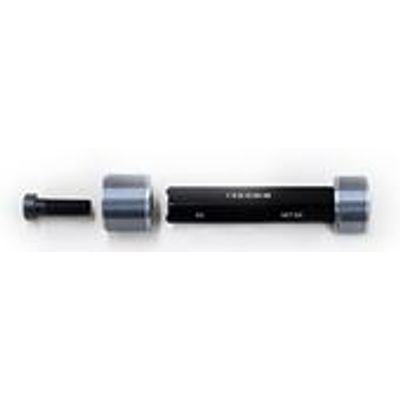
Trilock style (starting 7⁄8 up to 8 inches): Any thread plug gage over 1.5 nominal size is normally supplied in this style. These gages, like reversible style, can be reversed and re-installed on the handle “locking” it in place with a bolt and the three protruding nibs on the handle. Source: Gage Assembly Co.
Consider a car. Exactly how confident would you be driving a vehicle that was held together with a variety of nonconforming nuts, screws and bolts? Thread gages, in short, allow mass-produced threaded components to be gaged for uniform tolerance, which means strength, reliability and overall durability.
Depending on the item to be measured, there are several fixed limit gages that assist in the measurement process. Gages must be used to measure both the internal and external threads in order to comply with the class of fit as specified on the component drawing.
Fixed limit thread gages are the most popular measuring device on the market due to their reliability, cost effectiveness and ease-of-use. Machine operators and inspectors use them throughout assembly and at final inspection for quality assurance.
Thread ring gages (#0 to 15 inches): Adjustable style threaded rings are called “AGD” style in the U.S. Their blank lengths and finished dimensions are standardized by ANSI. All no-go rings are designated by a recessed band around the knurled portion. Source: Gage Assembly Co.
Frequently Asked Questions About Thread Gages
What is a thread gage?
Fixed limit thread gages are designed to simply tell you if your threaded component is in or out of tolerance.
What is a thread plug gage?
Thread plug gages check the internal thread of a threaded part. The “Go” plug gage should enter the threaded part. The “Not Go” should not enter the part. This simple process confirms the part is in tolerance. This applies for both metric and American inch sizes.
How do I check an external thread on my part?
External threads are checked using thread ring gages. Thread ring gages may be solid or adjustable design. The “Go” thread ring should allow the external threaded part to enter. The “Not Go” thread ring should not allow the external threaded part to enter. This simple process confirms the part is in tolerance. This applies for both metric and American inch sizes.
Can I check an internal threaded hole with a thread setting plug?
No. A thread setting plug is used only to set thread ring gages of the same size and pitch diameter.