


- Home
- Companies
- Biomass Engineering & Equipment (BE&E)
- Products
- BE&E - Vibratory Conveyors
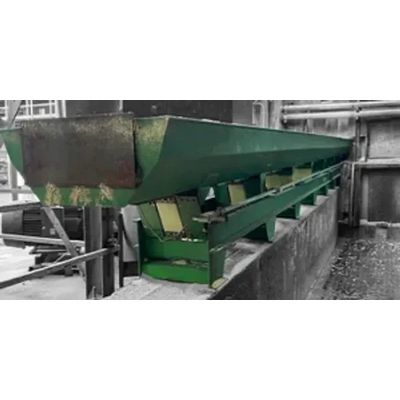
BE&E - Vibratory Conveyors
Since 1983, the VIBRAPRO line has been consistently producing some of the best vibratory conveyors in the industry. Time tested, our vibratory conveyors have been developed in response to the challenges facing our clients. Vibratory conveyors are a cost-effective means of transporting bulk solids of various weights and sizes. Through custom engineering, our vibratory conveyors are equipped to handle everything from lightweight material to heavy, abrasive applications.
- Low-Maintenance & Continuous Operation: Because there are few moving parts, vibratory conveyors require minimal maintenance. They can help ensure your production line continuously operates over extended periods.
- Gentle and Even Conveying: Vibratory conveyors can ensure the risk of product damage remains low.
- Wide Variety of Applications: Vibratory conveyors can be optimized for various materials and flow rates. Grains? Yes. Logs? Yes. Green woodchips? Yes.
- Solid Construction: The conveyors are robustly built, enhancing their durability and longevity in demanding environments.
VibraPro™ Light Duty Conveyors come equipped with carbon fiber Leaf Spring Plates that provide support and movement. With Trough pan thickness ranging from 1/8″ to 1/4″. Lighter duty performance comes with 12″ to 30″ width. Available in both balanced and unbalanced.
VibraPro™ Medium Duty Conveyors are equipped with thicker metal leaf springs that absorb and help propel the trough. Trough pan thickness range from 1/8″ to 3/8″ with pan widths of 12″ to 20′. Available in both balanced and unbalanced.
VibraPro™ Heavy Duty Conveyors come equipped with coil sprigs and arms for greater support and increased force transfer. Conveyor pan thickness can range from 1/4″ -1/2″, with custom thickness available. Trough width range from18″ to 20′. Available in both balanced and unbalanced.
Locations: under wave feeders, debarkers, log decks, canter lines, carriages, edgers, trimmers, sorters, yard cleanup
Options: screening, dewatering, metal detector, magnets, spouts, orientation, transfers, gates, dropouts
Material Handled: logs, lily pads, boards, bark, chips, sawdust, biomass, ash, clinkers, ferrous and nonferrous metal, rubber, dirt, food grade products
Balanced
Balanced vibrating conveyors have a greater mass frame that is isolated from the customer’s main support structure. The heavier frame softens the reaction forces that are created from the motion of the conveyor trough. The reduced motion of the conveyor frame is then isolated from the surrounding structure.
The trough is mounted to the frame using several springs, typically fiberglass (light duty) or coil (heavy duty), and driven using a belt-driven, shaft-mounted eccentric drive connection to the conveyor trough. Conveyors are tuned with the number of springs to run at a specific speed and the eccentric drive connection controls the amount of throw. An elastomeric coupling between the eccentric and the trough helps to reduce the power requirements to run the conveyor and protect the trough connection from stresses that could bring on failure.
These units are useful for screening, classifying, fluidizing, and de-watering. Maintenance on this conveyor is periodic bearing lubrication, belt inspection, and overall unit inspection.
Unbalanced
Unbalanced vibrating conveyors are required to be mounted securely to a solid structure, typically a customer’s concrete slab that can absorb the reaction forces that are created from the motion of the conveyor trough.
The trough is mounted to the anchored frame using several springs, typically fiberglass (light duty) or coil (heavy duty), and driven using a belt-driven, shaft-mounted eccentric drive connection to the conveyor trough. Conveyors are tuned with the number of springs to run at a specific speed and the eccentric drive connection controls the amount of throw. An elastomeric coupling between the eccentric and the trough helps to reduce the power requirements to run the conveyor and protect the trough connection from stresses that could induce failure.
Unbalanced vibratory conveyors are useful for screening, classifying, fluidizing, and de-watering. Maintenance on this conveyor includes periodic bearing lubrication, belt inspection, and overall unit inspection.
Feeders
- VibraPro™ offers a wide range of light, medium and heavy duty vibratory feeders for controlling the flow of bulk materials, Vibra-Pro feeder designs available in widths from 6 inches to 20 feet.
- VibraPro™ feeders are available in two-mass, natural frequency, and brute force, with a wide range of options including dust tight covers, screening decks, dewatering sections, abrasion resistant liners. Feeders can be designed to be supported from below or suspended from above on coil spring or rubber isolation springs to reduce dynamic reactions to surrounding structures.
- The feeders are available in a wide range of trough shapes. Feeders can be furnished with special trough coatings, such as neoprene, UHMW, Teflon, removable abrasive resistant steel plate, and anti-stick surfaces. The trough can be furnished in steel, stainless steel, and trough thicknesses of 1/8″ to 3/4″ to meet the most demanding requirements.
Screens
- The primary function of any screen is to separate particles of different sizes from one another. This is accomplished by passing mixed material over various screen surfaces so as to have the undersized particles pass through specifically sized apertures to another surface while retaining the oversized particles on the upper surface.
- Many materials act differently when vibrated depending on density, shape and moisture content. Always contact a VibraPro representative to assure proper sizing of any type of screening unit, from dewatering to waste recovery.