


- Home
- Companies
- Bell Cooling Towers
- Products
- BELL - Forced Draught Cooling Towers
BELL - Forced Draught Cooling Towers
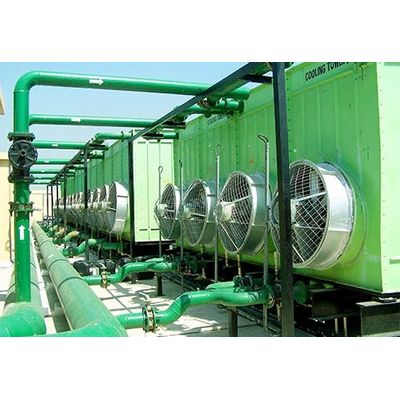
Forced draught cooling towers by Bell are mechanical draught towers equipped with one or more fans at the air intake, designed to deliver efficient cooling through the movement of dry air at a lower specific volume. Unlike induced draught systems, forced draught provides a lower air flow quantity for a given duty, leading to reduced power consumption. Bell employs Munters fills (now MM Aqua), which offer an extended surface area for water film to enhance air-water contact, contributing to effective cooling. These specially designed fills have a lower static resistance, reducing power requirements. Additionally, forced draught systems lower carryover and drift loss to 0.001% with D15 high-efficiency drift eliminators, mitigating drift nuisance and algae growth. They require less space, needing clearance only on one side. Having components near the base enhances stability and longevity, minimizes corrosion, motor burnouts, and improves maintenance access, making them ideal for small sites with limited space while induced draught is preferred for heavy-duty applications.
A forced draught tower is a mechanical draught tower having one or more fans installed in the air intake.
A fan with forced draught moves dry air while having a lower specific volume; as a result, its air flow quantity is lower for a given duty than that of a fan with induced draught.
Bell uses world renowned Munters fills (now MM Aqua), which are the heart of the cooling towers. The specially designed plates create an extended surface for the water film, maximizing air water contact and resulting in efficient cooling of the water.
These well researched fills have a lower static resistance than any other type of fill, which results in a reduction in the amount of power required. Finally, the velocity pressure that is thrown out into the environment by systems that use induced draught is put to good use by systems that use forced draught, which helps contribute to the reduction of power consumption.
Because the exit air velocity is lower in forced draught, the carryover loss is reduced to the greatest extent possible. They bring the overall drift loss down to 0.001% when coupled with these very high efficiency drift eliminators, which are of the D15 type. As a consequence of the high efficacy drift eliminators, the problem of drift annoyance as well as the growth of algae are greatly reduced, which leads to an improvement in air quality.
The forced draught only needs clearance on one side because air enters from one side and exits at the top. However, induced draught necessitates clearance on all sides, so it takes up additional space overall. In addition to the aforementioned benefits, forced draught also includes movable components close to the base, which further enhances stability and longevity. Because the fan moves dry air, corrosion is greatly reduced, and motor burnouts and condensation are avoided.
The fan is more accessible for Maintenance because it is lower to the ground. Since the top is removable, hence internals are also easily accessible.
Forced draught towers are recommended for small, compact sites with limited space. They are intended to provide effective cooling in such circumstances. However, induced draught towers are more suitable for heavy duty (with large fans) and high capacity applications.