

- Home
- Companies
- Trimech Engineers Pvt Ltd
- Products
- Belt Conveyor
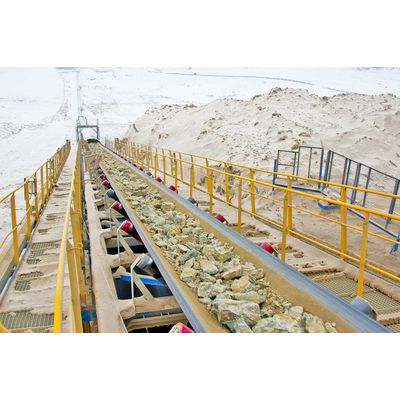
Belt Conveyor
Belt Conveyor is a one kind of mechanism that to transfer the material constantly. The belt works under the effect of frictional force. Belt conveyor are moving and carrying belts that ride on pulleys or rollers (two or more) that rotate around the belts and build a pull effect to drive the materials from one place to another. Today, they have become an indispensable tool in any material handling industry. They are also called conveyor belts. Their main aim is to carry any material or especially large materials in less time and without any workforce.
Belt conveyors are used across many industries. Each industry uses different types of belt conveyors according to their specs and requirements. With the help of belt conveyors, materials or goods move from the beginning to the end in bulk while maintaining the quality.
Just think of the hours of the workforce we would be blowing if we won’t have belt conveyors. In a nutshell, belt conveyors are the tried-and-true choices because of their ease and reliability. Let’s find out about its applications in depth.
- Belt conveyors are widely used in many industries. They make our work accessible by moving all sorts of bulk materials throughout their processes and thus reducing our operational time and costs.
- You will easily find belt conveyors at an airport. They are placed for organizing, loading, and unloading the luggage efficiently. They are a fusion of conveyor belts and advanced baggage handling systems.
- In the pharma industry, transportation of cardboard boxes full of medical supplies throughout the entire process of packaging and distribution is carried out by belt conveyors.
- Belt conveyors are also widespread among the logistics and warehouse industries to make sure items precisely sail around the system.
- Another use of belt conveyors is handling raw materials like food grains, molding sand, molding-cores, or moving them from place to place. They can be carried over tilts or bends with the help of belt conveyors.
- In mining and power plants, large amounts of material like coal, ores, and minerals are transported through tunnels, roads, and slopes on conveyor belts.
- In the food industry, products go through most of the processes on a conveyor belt. Items can be spread, sliced, powdered, cooked, or even branded — everything while riding on the belt.
- Belt conveyors are not merely used in large industries for carrying heavy materials. You might also have grabbed your food from a bowl or one of your plates in a fancy restaurant through such belt conveyors systems.
- Belt conveyors can also be seen in public places when we are moving our groceries to the cash counter in a supermarket, or the escalators while shopping in a mall, or moving skiers up to a slope, etc.
A belt conveyor is just a thick, broad, and durable belt attached to the conveyor in a loop form. The belt is fixed with two or more pulleys, rotors, or drums powered by motors.
The looped part is known as the conveyor belt and is usually made up of several layers of materials as per the use. The first layer gives formation to the belt, and the second layer helps in the transportation of the materials.
When the motor runs, the pulleys, rotors or drums turn. This turning causes the conveyor to start spinning in a single direction due to its friction with the belt.
If the belt conveyors are to be used at places where usually large or bulky objects are carried for a long-distance or duration, rollers are installed on the sides for support. They hold objects in position and keep the belt from weakening.
- Belt conveyors help plant productions to have free space.
- Endless supply of materials
- Helps to get the products and production in order
- High rate and speed of supply
- Needs less workforce
- Easy adjustments for loading and unloading
- Energy-efficient compared to other transports
- More efficiency and low cost
- Cleanliness in the workspace areas as the materials are carried on belt conveyors.
- It enables standardized product management
- Provides modularity and scalability
- Increase the security in operations by preventing any accidents
- Increase the productivity and quality of business