


- Home
- Companies
- Aqseptence Group GmbH
- Products
- Passavant Roepress - Belt Filter Press
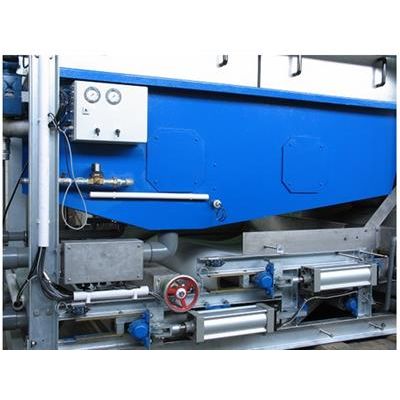
Passavant Roepress - Belt Filter Press
Roepress belt filter presses are used to dewater municipal and industrial effluent sludge of diverse composition and consistency because, compared to chamber filter presses and centrifuges, the cost of machinery and construction is very low. Not only the capital investment cost, but also running costs are lower. Flocculation of the sludge is decisive for a satisfactory working process and optimum results regards throughput, degree of separation and dewatering of the belt filter press. High throughputs and high solids contents in the cake at about 99% solids separation are only possible provided flocculation is at its optimum.
Unique Selling Point
- Efficient pre-dewatering. Straining of the flocculated sludge in large, slowly revolving pre-dewatering drum. No predewatering belt with complicated fittings.
- Repeatedly sealed, large size bearing located externally which can be used for thickening the sludge.
- High throughput. Hydraulic relief of the press zone thanks to excellent pre-dewatering.
- High final solids contents. Properly stepped increase of pressure and shear forces in the press and fulling zone.
- Self-sufficient spray water supply. Use of the clear filtrate from pre-dewatering to spray the belts and the drum.
- Minimal outside water requirements. Outside water only required starting up the machine and for post-cleaning.
- Minimal electricity consumption. Compared to decanters and chamber filter presses low current consumption. This is an advantage particularly for small and medium sized sewage plants and mobile dewatering plants.
- Low flocculent consumption. Thanks to pre-dewatering treating the flakes with care and simple, but reliable optimizing of flocculent dosage.
- Sturdy construction. Strong frame. Strong bearings and journals. High pressures possible. Careful treatment of filter belts. Even tension over the belt width and prevention of crease formation by pneumatic belt tension and belt control.
- Convenient accessibility. Convenient operation, maintenance and cleaning thanks to the open construction method. If required, the machine can be supplied sealed.
- Fully automatic operation. Automatic and consistent switching on and off of all drives. Automatic belt cleaning after switching off.
- High economy. Low investment and running costs. Fully automatic operation at minimal maintenance cost.
Flocculent is added to the sludge already in the inlet pipe. Flocculent is mixed in an inline mixer. It then enters the slowly revolving pre-dewatering drum. When the sludge is carefully taken to the end of the drum with the aid of special fittings, it releases already a large proportion of its water through the screen fabric. The out-flowing water collected in the filtrate tub and is practically free from solids.
The pre-dewatered sludge slides via a chute out of the drum onto the upper filter belt is then transferred once again to the lower filter belt and releases more water due to straining.
The floc structure of the sludge spread over the filter belts can be observed here. Little experience is required in order to optimize the flocculent dosage.
Between the filter belts, the sludge moves to the press zone and the subsequent fulling zone. It is dewatered further by increasing stepped press and shear forces and finally ejected.
The clear filtrate from the collecting tub is used to wash the belts with the aid of spray nozzles. Filtrate and wash water from the collecting tub, which are particularly soiled, can be returned to the inlet pipe and are then filtered once again in the dewatering drum.
A major field of application of Roepress is the dewatering of digested sludge containing a high proportion of inorganic or mineral substances. In addition, every dewaterable sludge can be dewatered with these machines. Depending on the type of disposal, whether agricultural use or going to the waste dump, post-conditioning using reactive or inert additives is possible with the Roemix throw mixer.