


- Home
- Companies
- BioDetection Systems (BDS) b.v.
- Products
- BDS CALUX - Bioassays
BDS CALUX - Bioassays
BDS offers an extensive panel of high-throughput-compatible CALUX® reporter assays that enable biological effect identification and quantification and effect-based compound detection. Our assays allow for the sensitive and precise detection of specific biological effects at the cellular level. This can be used for the identification of fractions and compounds with beneficial health effects. However, context-dependent repression or overstimulation of these pathways form the key to toxic effects of chemicals. For this, context-dependent thresholds are defined. In this way this panel can be used to predict major chemically-induced toxic effects such as sensitization, carcinogenesis and mutagenicity and, reproductive toxicity and endocrine disruption, related to health effects like birth- and fertility defects, cancer, metabolic syndrome and obesity.
Mammalian cells possess a wide range of mechanisms with which they can specifically respond to signals or stresses evoked by compounds they are confronted with. CALUX® (Chemically Activated LUciferase eXpression) assays form a panel of mammalian cell lines that were modified to produce a quantifiable response in addition to this natural response: If a cell is triggered to generate a response, a reporter gene (luciferase) is transcribed and translated into an enzyme that produces light during a reaction it catalyses. After addition of a substrate (luciferine), light production is quantified using a luminometer. The produced signal is proportional to the evoked effect. An overview of the CALUX® assays currently available is presented here.
Most cellular responses are mediated by a regulatory protein, which is a sensor that detects a certain event and subsequently incites the cellular response to this event. The regulator binds to a specific regulatory element which is present in DNA regions upstream of genes involved in the response. In the CALUX cell lines these regulatory elements were also placed in front of the luciferase (reporter) gene. Thereby, the production of the corresponding luciferase enzyme is coupled to the natural response of the cell.
Whereas most genes may be involved in multiple responses, the molecular design of the CALUX assays ensures that the observed response is highly specific for the effect of interest.
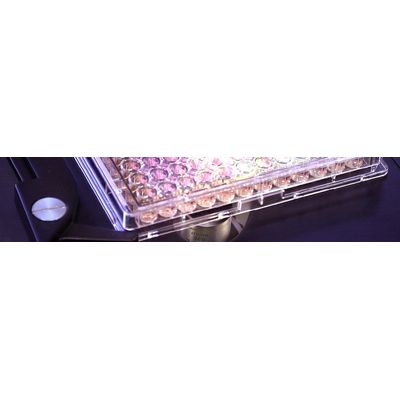
CALUX® assays may be used for testing of single compounds as well as complex mixtures. The cells are cultured in well plates (usually 96 or 384 wells), which allows for increased throughput and automated handling. Subsequently, they are exposed to a dilution series of the test compound or a dilution series of an extract of the test sample. Along with the test samples, the cells are also exposed to a concentration series of a reference compound. After a certain exposure time, the light production in the individual wells is quantified using a luminometer. The activity evoked by the test compound or test sample is subsequently derived by interpolation in the response curve of the reference compound and is expressed in equivalences of this reference compound.
Agonism/antagonism
All CALUX®-based assays and most other cell-based assays can be run in two different modes, allowing to distinguish between agonists and antagonists. In the antagonistic mode competition with the reference compound is assessed.
All CALUX®-based assays and most other cell-based assays can also be run with additional metabolic fractions. In case of the U2OS-based CALUX assays, a modular system can be used with the option to include phase I or II metabolism separately or together, giving insight in the metabolic route to which a specific compound (or a mixture) is susceptible.
An overview of the CALUX® assays that are currently available is presented below. For most assays, procedures to distinguish between agonists and antagonists are available, as well as modular metabolic modules. In addition to the CALUX assays that are currently available, BDS is constantly working on new reporter cell lines and new applications with these cell lines, as well as complementary technologies for relevant applications.