


- Home
- Companies
- Wuxi BioCell Environmental Technology ...
- Products
- BioCell - MBBR & IFAS Media
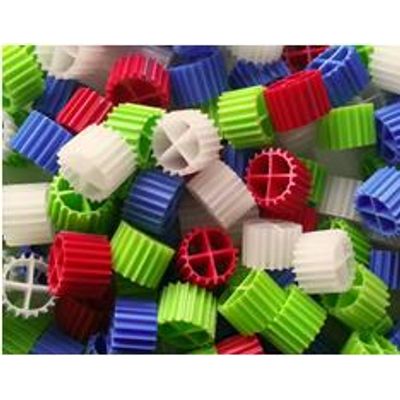
BioCell - MBBR & IFAS Media
The BioCell media is for application in Moving Bed Biofilm Reactor (MBBR) systems for the provision of a self-sloughing, auto-regulating attached grov\th biofilm treatment process. The media can be used for a single pass MBBR treatment process or in increase the effective capacity of existing activated sludge systems as an Integrated Fixed-filmActivated Sludge (IFAS) process.
The BioCeir" media used in MBBRor IFAS are continuously in motion caused by air Injection and agitator. The specific density of the media can be adjusted from 0.95 to 1.05 g/cml depending on customers` demand. However it has to be considered that the actual density of the carrying media will Increase as the biofilm develops on the media surface.
Media provides two important functions: The protected internal surface area allows biofilm to attach while supporting either the heterotroph / autotroph bacteria Second, the millions of pieces of media act as a shearing device on the course air bubble to maximize oxygen transfer.
Moving Bed Biofilm Reaction (MBBR)
The main characteristic of Moving Bed Biological Reactor (MBBR) configurations is that there is no sludge (ejy^cjg from a secondary clarifier. MBBR is essentially a simple, once-through process, where all of the biological activity takes place on the biomass earners. MBBR is usually followed by a solids separation system such as a secondary clarifier or DAF, in order to separate bio-solids produced in the process from the final effluent. The main advantage of MBBR is robust and simple reduction of soluble pollutants (soluble BOD or COD, NH4 +, etc.), with minimal process complexity, utilizing a significantly smaller footprint when compared to conventional aerobic treatment methods. MBBR is typically used for either high load industrial applications or for robust simple-to-operate municipal facilities.
Integrated Fixed-lm Activated sludge (IFAS)
The Integrated Fixed-film Activated Sludge (IFAS) process combines the advantages of conventional activated sludge with those of biofilm systems by combining the two technologies in a single reactor. Typically, an IFAS configuration will be similar to an activated sludge plant (utilizing all of the different process configurations such as MLE, UCT, Bardenpho, etc.), with biomass carriers introduced into carefully selected zones within the activated sludge process. This allows two distinct biological populations to act synergistically, with the MLSS degrading most of the organic load (BOD), and the biofilm creating a strongly nitrifying population for oxidation of the nitrogenous load (NH4+). IFAS is typically used to upgrade existing plants in order to enable extensive Nitrogen removal, or in designing new plants with significantly smaller footprints for extensive BOD and Nitrogen removal.
MBBR AEROBIC REACTOR
In aerobic aeration, the media is fully agitated and mixed with water; meanwhile the air is segmented into small bubbles, which increases the contact area between biological membrane and oxygen, it also could increases the efficiency of oxygen transfer
MBBR ANOXIC REACTOR
Under anaerobic conditions, water flow and media be fully agitated by agitator in order to let the biofilm and the pollutants are fully exposed, and achieve the purpose of biological decomposition.
MBBR Mixing Process
The process of MBBR mixing with activated sludge could improve the treatment capacity more than 50% under the premise of not increasing the tank
volume.
MBBR Front-loading Process
Applicable in the treatment of high concentration organic wastewater greatly improved activated sludge settling performance and the effluent water quality and has a higher impact load capacity.
MBBR Post-loading Process
It can improve the efficiency of nitrification and denitrification, and also improve the removal rate of organic matter and ammonia nitrogen.