


- Home
- Companies
- Entsorga Italia Spa
- Products
- Biofilters
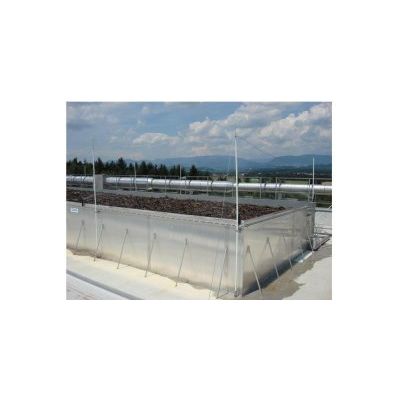
Biofilters
Biofiltration is the proven and reliable technology for odour control in a wide range of industrial activity and in particular for composting and waste treatment plant. It is natural, adaptable, effective and affordable. Lots of human activity, from industrial to agricultural, on both small and large scale, must manage the problem of unpleasant odours emitted into the atmosphere. Odour reduction is a fundamental requirement not only in order to render the work environment more pleasant but most of all, so that local inhabitants accept the activity.
Biofiltration is the most adaptable mechanism for odour reduction as it is natural, ecological and technologically convenient.
Biofiltration is a biologic process that reduces the odours present in gaseous currents through microbe heterogeneous population, using bacterium, mildews and yeasts that work as a natural removing agent. These microorganisms metabolise most of the organic and inorganic compounds through a large series of reactions that transform the compounds into odourless products. The microbe colony necessary for the biofiltration acts well on the surface of a proper natural support, through which the air to be treated is blown. The support, which is the `bed` of the biofilter may be formed by mould, peat, woody pieces, green compost, cortices or by a mixture of these and other materials, including plastics.
The odorous gaseous substance is absorbed by the filtering material and degraded by the microbe flora, which uses it as nourishment together with part of the filtering material itself. The biologic activity requires the oxygen that is provided by the same gaseous current entering the biofilter. The material surface emits carbon dioxide (CO2), water, inorganic compounds and biomass. At the mouth of the biofilter there will be very small quantities of the incoming pollutants. If we compare the costs of biofiltration to other air depuration systems, biofiltration has more advantages and this technology is more favourable as far as the services / price relationship is concerned.
The system offers the following advantages:
- It is completely natural process: chemical substances of synthesis are not used. The process is not selective. Through its biologic and not chemical processes the biofilter can reduce different types of odorous compounds.
- It is easy to instal and doesn`t requires any special utility or civil works.
- Low energy cost: the high porosity make the pressure drop very low and consequently makes the energy consumption low.
- Low maintenance: only periodical tests are necessary to check the temperature and humidity of the biofilter media.
- Long duration: the filtering material has to be subtituted every 4-5 years.At the end of its working life, the disposal of the biofilter media has no environmental consequence
- High reliability: the Entsorga biofilter is proven by a relevant number of installations and by the related of data available.
Guaranteed Emission Limits
- Odour concentration: 300 Odorimetric Units
- Ammonia (NH3): 5 mg/Nm3
- Hydrogen Sulfide (H2S): 5 mg/Nm3
These above are the most commont limits, it is also possible to guarantee lower emissions (i.e. 200 odorimetric units) according with regional or national regulations.
Biofiltration finds easy application in each field where it is necessity to eliminate unpleasant smells induced from organic and inorganic substances present in the effluent to be depured, with lower-middle concentrations.
- Food industries
- Animal food industries
- Waste disposal Systems
- Purifying waters and refusals treatment systems
- Plastics treatment industries
- Paper manifacturing industries
- Typographical industries
- Petrochemical industries
- Production of adhesives and dissolvents industries
- Tobaccos manufacture
- Breedings
- Oils recovery industries
- Butchering
- Paint job plants