

- Home
- Companies
- Bioaction Pty Ltd.
- Products
- FiltaMin - Biological Growth Media
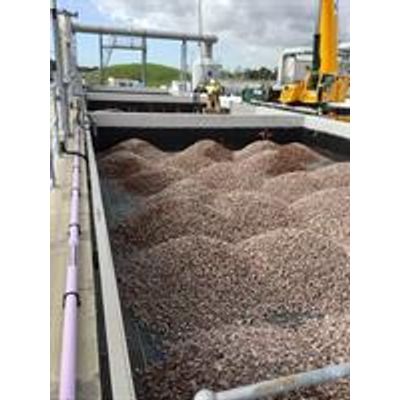
FiltaMin - Biological Growth Media
FiltaMin mineral is characterised by complex three-dimensional structures with large, cage like cavities that can accommodate sodium, calcium, or other cations (positively charged atoms or atomic clusters); water molecules; and even small organic molecules. Because of its ability to interact with organic molecules, it adds another dimension to biological growth media performance by absorbing chemical compounds that are used as feedstock for biological digestion. Its surface structure and its moisture retention make it a preferred host for biological colonisation.
The main advantages of the FiltaMin biofilter media compared to the compost biofilter media:
- The media never has to be replaced, as in the case of compost. In the case of compost, once the nitrogen and phosphorus, initially present in the compost are exhausted, the compost has to be changed.
- Compost media eventually begins to compact, in spite of adding wood chips to provide support. The growth of biomass (microorganisms) due to biodegradation also causes the compost to become heavier and settle. This type of settling results in increased gas-phase pressure drop, which causes the gas flow to actually decrease, since the gas blower has to operate against a high-pressure drop.
- In some cases, when air contaminants contain nitrogen or sulfur or oxygen, intermediate products of biodegradation (biotransformation) may be acidic, which causes the pH in the biofilter bed to decrease. For example, when hydrogen sulfide is bio-transformed to sulfate, the pH in the bed decreases. In compost beds, declining pH results in decreased bioactivity, which eventually causes the entire bed to acidify and shutdown.
- The biodegradation rates are much higher than in compost beds. This is mainly due to the higher surface area and increased the concentration of immobilized microorganisms when compared to compost media. Hence, the volume of biofilter bed is much smaller than the volume of compost required for the same destruction efficiency.
- In compost biofilters, the compost has to be replaced periodically, to replenish the nitrogen and phosphorus and remove the excess biomass that results in plugging and settling.
- In compost beds, gas channeling is a big problem, especially since compost beds are shallow with large cross-sectional areas. As biomass growth begins to plug the bed, gas begins to bypass compost regions that have increased biomass concentrations.
- Where the compost is a blend of organic material the ability to create a homogeneous media profile is limited to the blending equipment (often a loader) and the physical characteristics of the individual components. Disaggregation of the media is due mainly to particle size and bulk density variations. This problem further exaggerates the composting problem where irregular composting occurs which is indicated by the irregular surface of the compost bed.
- Transfer of oxygen into compost materials is very inefficient since oxygen is also consumed by compost due to intrinsic biodegradation of the organic fraction, present in compost media. Hence, if air is blown through moist compost media, the air leaving will have increased levels of carbon dioxide gas. Due to inefficient oxygen transfer, if the water content of compost material is not maintained in a narrow range, anaerobic regions are created in the compost material, wherein anaerobic microorganisms begin to thrive and anaerobic microorganisms are known to create acidic by-products, which creates pH in the compost material to decrease. FiltaMinTM media is very open, and high gas velocities can be maintained, the oxygen transfer is much higher, and hence anaerobic regions are not created in the biofilter bed.
- The image above shows the typical degradation process of a soil bed using compost media. At early stages, the media operates effectively but the introduction of oxygen, nutrient and moisture promotes biodegradation of the compost media. As the media degrades at the interface of the inflow air it compacts and causes blockages and preferential pathways or channeling.
FiltaMinTM Biofilter Media
FiltaMinTM is a natural sedimentary mineral containing as the main crystalline component the mineral clinoptilolite, together with minor amounts of mordenite, quartz, smectite and mica.
This zeolitic mineral is characterized by complex three-dimensional structures with large, cage like cavities that can accommodate sodium, calcium, or other cations (positively charged atoms or atomic clusters); water molecules; and even small organic molecules.
Because of their ability to interact with organic molecules, they add another dimension to biological growth media by retaining chemical compounds that are feed stocks for biological digestion. The surface structure of the mineral its moisture retention make it a preferred structure for biological colonization.
MAJOR ELEMENTS CHEMICAL ANALYSIS OF FILTAMIN
- BIOFILTER)–)SOIL)BED)DEGRADATION)
- EARLY) DEGRADATION) )
- INCREASED)STATIC)PRESSURE) SIGNICANT)SLUMPING) )
- BED)FAILURE)) SIGNICANT)FLOW)RESTRICTION)) &)CHANNELING) ) )SOIL)BED)LIFE)CYCLE)6918)MONTHS)
- Major Element (%) Si02 68.26 Ti02 0.23 Al03 12.99 Fe203 1.37 MnO 0.06 MgO 0.83 CaO 2.09 Na20 0.64 K20 4.11 P205 0.06 S03 0.00 LOI 8.87 TOTAL 99.51
- Low pressure drop
- 40% porosity
- Even air diffusion across filter bed
- Free draining
- Even moisture distribution – high capillary action
- Structural integrity – no compaction or channeling
- Lifelong operation
- Supply and installation services
- Design services
- Irrigation system